
LightBlog

jeudi 14 juillet 2022

Google removes ‘Permissions’ list from Play Store app listings

While on the one hand, Google has introduced a new “Data Safety” section on the Play Store to provide users with more information about how apps use their data, on the other, the company is removing crucial details from app listings. In March this year, Google removed the ‘Updated on’ section from Play Store listings for some users. Now, it’s getting rid of the ‘Permissions’ list.

For the unaware, app listings on the Google Play Store include a ‘Permissions’ section that lists all the permissions required by each app. It lets users easily check all permissions required by an app without installing it on their device, making it a handy feature for privacy-conscious users. However, according to Mishaal Rahman, Google seems to have removed it from Play Store listings for all apps.

In a recent tweet, Rahman shared screenshots of the Play Store listing for the Facebook app before and after the change went into effect. As you can see, the updated listing no longer shows the ‘Permissions’ list, so you can no longer check the app permissions before installing the app.
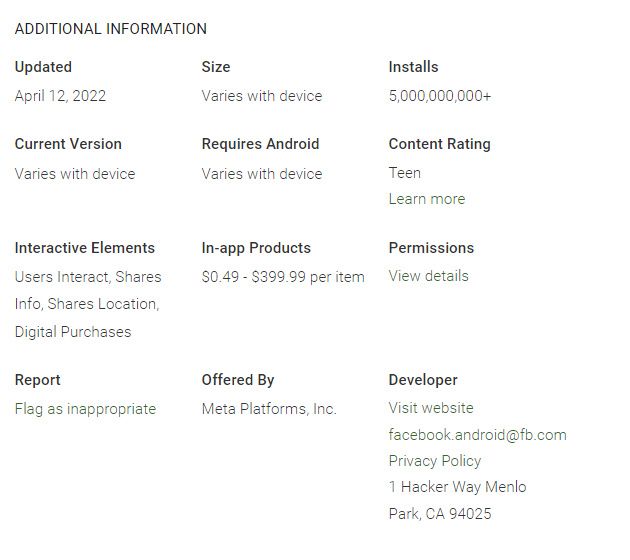
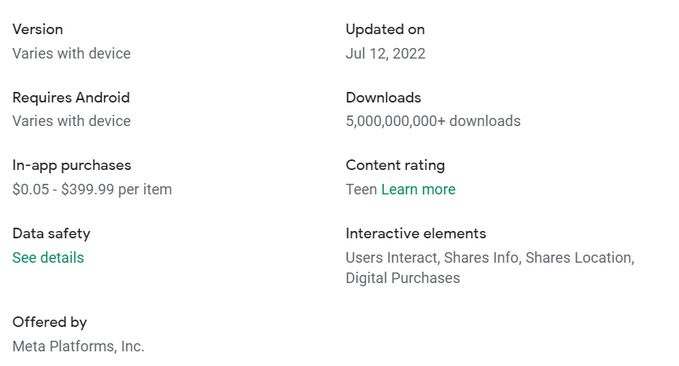
Screenshot of Facebook play store listing additional information section. Screenshot of Facebook updated Play Store listing without Permissions list.

We’re not sure why Google has gone ahead with this change, and the company is yet to release an official statement on the matter. But we suspect it has something to do with the new Play Store Data Safety section, which is currently rolling out to users. The new Data Safety section provides users with information about how apps use their data in the Play Store listing. The information provided in the Data Safety section is a bit easier to digest for the average user, making it a bit more useful than the Permissions list, which doesn’t offer an explanation for the required permissions.

Those with a fair understanding of Android app permissions can still access the information by using the Aurora Store, a FOSS Google Play Client, or by inspecting the app’s manifest.

The post Google removes ‘Permissions’ list from Play Store app listings appeared first on XDA.


from XDA https://ift.tt/AxMwUaY
via IFTTT

Google removes ‘Permissions’ list from Play Store app listings

While on the one hand, Google has introduced a new “Data Safety” section on the Play Store to provide users with more information about how apps use their data, on the other, the company is removing crucial details from app listings. In March this year, Google removed the ‘Updated on’ section from Play Store listings for some users. Now, it’s getting rid of the ‘Permissions’ list.

For the unaware, app listings on the Google Play Store include a ‘Permissions’ section that lists all the permissions required by each app. It lets users easily check all permissions required by an app without installing it on their device, making it a handy feature for privacy-conscious users. However, according to Mishaal Rahman, Google seems to have removed it from Play Store listings for all apps.

In a recent tweet, Rahman shared screenshots of the Play Store listing for the Facebook app before and after the change went into effect. As you can see, the updated listing no longer shows the ‘Permissions’ list, so you can no longer check the app permissions before installing the app.

Screenshot of Facebook play store listing additional information section. Screenshot of Facebook updated Play Store listing without Permissions list.

We’re not sure why Google has gone ahead with this change, and the company is yet to release an official statement on the matter. But we suspect it has something to do with the new Play Store Data Safety section, which is currently rolling out to users. The new Data Safety section provides users with information about how apps use their data in the Play Store listing. The information provided in the Data Safety section is a bit easier to digest for the average user, making it a bit more useful than the Permissions list, which doesn’t offer an explanation for the required permissions.

Those with a fair understanding of Android app permissions can still access the information by using the Aurora Store, a FOSS Google Play Client, or by inspecting the app’s manifest.

The post Google removes ‘Permissions’ list from Play Store app listings appeared first on XDA.


from XDA https://ift.tt/Gg7CcNa
via IFTTT

Qualcomm hints at new chip for Wear OS smartwatches

We always need more power. Whether it’s our laptops, smartphones, or even smartwatches. It looks like the latter category might get a boost soon, as Qualcomm has taken the time to release a ten-second teaser trailer on its Twitter account. The small clip has exciting music and shows us an animated image of a Snapdragon Wear chipset being born. But what does it all mean? Let’s dive in.

As the chipset moniker comes into existence in the trailer, the camera transitions to a slogan: “Wear what matters.” As you can probably guess, this is a teaser for a new chipset that will power smartwatches – a new Snapdragon Wear chipset. Unfortunately, this is all we know at this point. It is hard to say when exactly this will come to fruition; we can probably bet that this summer is a good guess, as the company has stated that it is “coming soon.”

So far, the firm has released the Snapdragon Wear 1100 and the Wear 1200. Along with the Snapdragon Wear 2100, Wear 2500, and Wear 3100. Its most recent iteration of its wearable Snapdragon SoC has been the Wear 4100 and Wear 4100 Plus. The Snapdragon Wear 4100 series offered improved connectivity, processing, and power efficiency over its predecessors.

Although Qualcomm didn’t give us much, we know from what was previously reported that the next generation of smartwatch processors could go under the Snapdragon Wear 5100 moniker. The new chipsets could utilize MEP and MLP construction, and should again improve upon their predecessors. For now, we will have to wait and see what improvements will be revealed.

A new Snapdragon Wear chipset for a new generation of wearables

The Snapdragon Wear 4100 series was revealed back in June of 2020, so this could be just the right time for something new to come along. With that said, the new chipset could create the perfect storm with Google’s Wear OS 3, which has not arrived on many smartwatches, despite it being the latest smartwatch OS.


Source: Snapdragon (Twitter)

The post Qualcomm hints at new chip for Wear OS smartwatches appeared first on XDA.


from XDA https://ift.tt/tYe5GbO
via IFTTT

Qualcomm hints at new chip for Wear OS smartwatches

We always need more power. Whether it’s our laptops, smartphones, or even smartwatches. It looks like the latter category might get a boost soon, as Qualcomm has taken the time to release a ten-second teaser trailer on its Twitter account. The small clip has exciting music and shows us an animated image of a Snapdragon Wear chipset being born. But what does it all mean? Let’s dive in.

As the chipset moniker comes into existence in the trailer, the camera transitions to a slogan: “Wear what matters.” As you can probably guess, this is a teaser for a new chipset that will power smartwatches – a new Snapdragon Wear chipset. Unfortunately, this is all we know at this point. It is hard to say when exactly this will come to fruition; we can probably bet that this summer is a good guess, as the company has stated that it is “coming soon.”

So far, the firm has released the Snapdragon Wear 1100 and the Wear 1200. Along with the Snapdragon Wear 2100, Wear 2500, and Wear 3100. Its most recent iteration of its wearable Snapdragon SoC has been the Wear 4100 and Wear 4100 Plus. The Snapdragon Wear 4100 series offered improved connectivity, processing, and power efficiency over its predecessors.

Although Qualcomm didn’t give us much, we know from what was previously reported that the next generation of smartwatch processors could go under the Snapdragon Wear 5100 moniker. The new chipsets could utilize MEP and MLP construction, and should again improve upon their predecessors. For now, we will have to wait and see what improvements will be revealed.

A new Snapdragon Wear chipset for a new generation of wearables

The Snapdragon Wear 4100 series was revealed back in June of 2020, so this could be just the right time for something new to come along. With that said, the new chipset could create the perfect storm with Google’s Wear OS 3, which has not arrived on many smartwatches, despite it being the latest smartwatch OS.


Source: Snapdragon (Twitter)

The post Qualcomm hints at new chip for Wear OS smartwatches appeared first on XDA.


from XDA https://ift.tt/5AWgTvM
via IFTTT

mercredi 13 juillet 2022

There’s still time to grab a $35 Blink Video Doorbell on Prime Day

Ring isn’t Amazon’s only connected camera brand and Blink, the other, is getting in the Prime Day spirit as well. As part of Amazon’s flagship shopping event on July 12-13, there’s a hot deal in play on the Blink Video Doorbell, taking 30% off its already attractive price.

It isn’t as advanced as some competing video doorbells, but at $35 it certainly represents an attractive price point, particularly for those taking their first steps.

The Blink Video Doorbell can operate either wired to an existing chime or wirelessly, with up to two years of battery life. Daytime video is captured in 1080p, while when the sun goes down the infrared view kicks in. As with any connected camera, the Blink Video Doorbell has a companion app with full support for live view and notifications for motion events and bell presses. With two-way audio, you can hear and speak to whoever is at your door.

As it takes AA batteries, too, there’s never a time you need to be without coverage while the battery charges. It’s weatherproof, too, as you would expect, and unlike the Ring doorbells, can be used to its fullest without a subscription plan.

    Blink Video Doorbell
    A budget alternative to Ring with the option of local storage if you also grab the Sync Module 2.

The caveat on that is that the additional $35 Sync Module 2 is required. With this, you can save local footage from the Blink Video Doorbell and up to nine additional cameras. Blink does have a cloud plan that will offer storage and access to your footage, but the Sync Module 2 is better value overall. If you spring for that, you’ll be paying $30 per year per device or $100 per year for a plan that covers up to 10 devices.

But since it’s Prime Day you can also save on the Sync Module 2. For an additional $16 you can get a bundle containing both the Blink Video Doorbell and Sync Module 2 for just $51. Whichever you go for, time is running out, since Prime Day ends at the close of play on July 13.

The post There’s still time to grab a $35 Blink Video Doorbell on Prime Day appeared first on XDA.


from XDA https://ift.tt/a64u3cm
via IFTTT

There’s still time to grab a $35 Blink Video Doorbell on Prime Day

Ring isn’t Amazon’s only connected camera brand and Blink, the other, is getting in the Prime Day spirit as well. As part of Amazon’s flagship shopping event on July 12-13, there’s a hot deal in play on the Blink Video Doorbell, taking 30% off its already attractive price.

It isn’t as advanced as some competing video doorbells, but at $35 it certainly represents an attractive price point, particularly for those taking their first steps.

The Blink Video Doorbell can operate either wired to an existing chime or wirelessly, with up to two years of battery life. Daytime video is captured in 1080p, while when the sun goes down the infrared view kicks in. As with any connected camera, the Blink Video Doorbell has a companion app with full support for live view and notifications for motion events and bell presses. With two-way audio, you can hear and speak to whoever is at your door.

As it takes AA batteries, too, there’s never a time you need to be without coverage while the battery charges. It’s weatherproof, too, as you would expect, and unlike the Ring doorbells, can be used to its fullest without a subscription plan.

    Blink Video Doorbell
    A budget alternative to Ring with the option of local storage if you also grab the Sync Module 2.

The caveat on that is that the additional $35 Sync Module 2 is required. With this, you can save local footage from the Blink Video Doorbell and up to nine additional cameras. Blink does have a cloud plan that will offer storage and access to your footage, but the Sync Module 2 is better value overall. If you spring for that, you’ll be paying $30 per year per device or $100 per year for a plan that covers up to 10 devices.

But since it’s Prime Day you can also save on the Sync Module 2. For an additional $16 you can get a bundle containing both the Blink Video Doorbell and Sync Module 2 for just $51. Whichever you go for, time is running out, since Prime Day ends at the close of play on July 13.

The post There’s still time to grab a $35 Blink Video Doorbell on Prime Day appeared first on XDA.


from XDA https://ift.tt/CjVGe3X
via IFTTT

Razer’s latest Blade laptops are up to $400 off on Prime Day

Amazon Prime Day is on its way out, but there are still some great deals you can take advantage of right now. Case in point, the Microsoft Store is offering some hefty discounts on a couple of Razer Blade laptops to line up with Prime Day – and they’re the latest models available, too. We haven’t been able to find these prices anywhere else, so it’s a great opportunity to buy yourself a great gaming laptop.

First off, there’s the Razer Blade 15. The configuration Microsoft is offering comes with an Intel Core i7-12700H, which is a 14-core, 20-thread processor with clock speeds up to 4.7GHz. That’s paired with an Nvidia GeForce RTX 3080 Ti, currently the fastest laptop GPU out there, and you also get 32GB of RAM and a 1TB SSD. This is a beastly laptop and it will handle just about any game you throw at it just fine. And to match that, you get a 15.6-inch Full HD display with an ultra-fast 360Hz refresh rate, allowing for split-second reactions in competitive titles.

Of course, you usually have to pay the Razer tax – these laptops don’t come cheap.  This configuration usually costs $3,699.99, but Microsoft is slashing a whopping $400 off its usual price, so you can get it for $3,299.99. Granted, that’s still not cheap, but for a top-of-the-line laptop like this, it’s a solid price, and certainly more palatable than MSRP.

    Razer Blade 15 ($400 off)
    The Razer Blade 15 is a powerful 15-inch gaming laptop with 12th-gen Intel processors and Nvidia graphics, It also has a super-fast 360Hz display, and right now, it's $400 cheaper than usual.

The Razer Blade 15 even has a great webcam with 1080p resolution and Windows Hello facial recognition, things you don’t see that often in gaming laptops. There are also plenty of ports with one Thunderbolt 4 port, one standard USB-C port, three USB Type-A ports, a  headphone jack, and an SD card reader.

If you want something a bit more compact, though, there’s the Razer Blade 14, too. This one is powered by an AMD Ryzen 9 6900HX, an 8-core, 16-thread processor that boosts up to 4.9GHz. This configuration includes an Nvidia GeForce RTX 3070 Ti GPU, which is still more than enough to run modern games, and you also get 16GB of RAM and a 1TB SSD. You can enjoy your games on a Quad HD display with a 165Hz refresh rate, too, giving you a great balance of image quality and smoothness.

Usually, this configuration goes for $2,599.99, but the Microsoft Store is giving you $300 off on, so this powerful and compact laptop can be yours for $2,299.99.

    Razer Blade 14 ($300 off)
    The Razer Blade 14 is a compact laptop that still packs top-tier AMD processors and powerful Nvidia graphics. Plus, it has a Quad HD 165Hz display that's great for gaming and productivity. It's $300 off, so it's a great time to buy it.

Just like with the Blade 15, you also get a Full HD webcam with Windows Hello above that display. Connectivity is solid, too, with two USB Type-C ports (with DisplayPort and charging), two USB Type-A ports, and HDMI. There’s no Thunderbolt here, because it’s an AMD laptop. We should also mention you can’t upgrade the RAM on the Blade 14, though 16GB should be good enough for a long time.

Unlike “proper” Prime Day deals, these Razer Blade discounts are technically running until the end of the week, but they may go out of stock. In fact, at one point the Razer Blade 17 also seemed to have a deal available, but it’s already sold out, so take advantage of these while you can.

The post Razer’s latest Blade laptops are up to $400 off on Prime Day appeared first on XDA.


from XDA https://ift.tt/9QzJmEo
via IFTTT