LightBlog

jeudi 13 août 2020

Mozilla lays off 250 employees to restructure its business but is reportedly still financially secure

The Mozilla Corporation recently announced that it was laying off approximately 250 employees in an attempt to secure the organization’s financial future. The layoffs were announced by the CEO of Mozilla Corporation and Mozilla Foundation Chairwoman, Mitchell Baker, in a public blog post, which also highlighted the company’s plans for the foreseeable future.

In the blog post, Baker wrote, “Today we announced a significant restructuring of Mozilla Corporation. This will strengthen our ability to build and invest in products and services that will give people alternatives to conventional Big Tech. Sadly, the changes also include a significant reduction in our workforce by approximately 250 people.”

Baker further revealed that the layoffs and restructuring were a part of the organization’s need to adapt its finances in a post-COVID-19 world and focus on commercially viable products that would help the organization generate revenue in the long term. This led some to speculate that Mozilla was facing financial troubles and had failed to renew its search deal with Google, which has historically accounted for 75-95% of the organization’s annual budget.

However, sources familiar with the matter have confirmed to ZDNet that Mozilla is financially sound and the layoffs were just a result of over-staffing in areas that the organization was not planning on prioritizing going forward. The sources also revealed that Mozilla and Google are expected to extend their current search deal for another three years at an estimated price tag of $400 million-$450 million per year. Details about the extended search deal will, most likely, be revealed later this year in November, when the organization is scheduled to disclose its 2019 financial figures.

In a statement to ZDNet, a Mozilla spokesperson said, “Mozilla’s search partnership with Google is ongoing, with Google as the default search provider in the Firefox browser in many places around the world. We’ve recently extended the partnership, and the relationship isn’t changing.”

Going forward, the Mozilla Corporation will prioritize commercialization efforts in the short-term, while work on open standards and protocols will take a back seat. However, Mozilla doesn’t plan to phase out its work in the web development community and will, most likely, pick up where it left off after its subscription-based services ensure long-term business survivability.


Source: The Mozilla Blog, ZDnet (1,2)

The post Mozilla lays off 250 employees to restructure its business but is reportedly still financially secure appeared first on xda-developers.


from xda-developers https://ift.tt/33Uiavz
via IFTTT

Xiaomi has no plans to launch the Mi 10 Ultra or Redmi K30 Ultra globally

Xiaomi recently launched the Mi 10 Ultra and the Redmi K30 Ultra, two phones that commemorate the company’s 10 years in the smartphone market. While the Mi 10 Ultra includes some of the best consumer-ready technologies that Xiaomi has to offer, the Redmi K30 Ultra represents Xiaomi’s insane value proposition with a low price tag but a heavy punch. Both smartphones are exciting for their own reasons. But as it turns out, Xiaomi currently has no plans to launch the Mi 10 Ultra or the Redmi K30 Ultra globally, limiting them to the Chinese market.

According to reports by GSMArena and AndroidAuthority citing Xiaomi representatives, the Chinese OEM is currently limiting the Mi 10 Ultra and the Redmi K30 Ultra to China only.

Both Mi 10 Ultra and Redmi K30 Ultra won’t be launching outside of Mainland China.

Further, Xiaomi has also ruled out the devices releasing globally under the POCO brand, as one could see in the case of the POCO F2 Pro/Redmi K30 Pro.

Redmi K30 Ultra

If you have been keeping track of our coverage, especially of the Redmi K30 Ultra “cezanne“/M2006J10C, you’d notice that we could not explicitly confirm that the device would launch outside of China, namely because of the fact that it came with a MediaTek Dimensity SoC that had remained a China-exclusive till then. However, more recently, MediaTek had mentioned that the Dimensity SoCs would begin shipping in devices outside of China in Q3 2020. This, coupled with the existence of the M2006J10G as well as the existence of global beta builds for cezanne up until 14th July, had given us a sliver of hope that the device would indeed make its way outside of China. While we are still hopeful that Xiaomi may have a change of heart in the future, this confirmation from company officials is a conclusive statement that the device will not ship outside of China officially. No such indications had indicated for the Mi 10 Ultra, so its China-exclusivity was not a surprise.


Source: GSMArena, AndroidAuthority

The post Xiaomi has no plans to launch the Mi 10 Ultra or Redmi K30 Ultra globally appeared first on xda-developers.


from xda-developers https://ift.tt/3kFQUab
via IFTTT

mercredi 12 août 2020

Xiaomi has no plans to launch the Mi 10 Ultra or Redmi K30 Ultra globally

Xiaomi recently launched the Mi 10 Ultra and the Redmi K30 Ultra, two phones that commemorate the company’s 10 years in the smartphone market. While the Mi 10 Ultra includes some of the best consumer-ready technologies that Xiaomi has to offer, the Redmi K30 Ultra represents Xiaomi’s insane value proposition with a low price tag but a heavy punch. Both smartphones are exciting for their own reasons. But as it turns out, Xiaomi currently has no plans to launch the Mi 10 Ultra or the Redmi K30 Ultra globally, limiting them to the Chinese market.

According to reports by GSMArena and AndroidAuthority citing Xiaomi representatives, the Chinese OEM is currently limiting the Mi 10 Ultra and the Redmi K30 Ultra to China only.

Both Mi 10 Ultra and Redmi K30 Ultra won’t be launching outside of Mainland China.

Further, Xiaomi has also ruled out the devices releasing globally under the POCO brand, as one could see in the case of the POCO F2 Pro/Redmi K30 Pro.

Redmi K30 Ultra

If you have been keeping track of our coverage, especially of the Redmi K30 Ultra “cezanne“/M2006J10C, you’d notice that we could not explicitly confirm that the device would launch outside of China, namely because of the fact that it came with a MediaTek Dimensity SoC that had remained a China-exclusive till then. However, more recently, MediaTek had mentioned that the Dimensity SoCs would begin shipping in devices outside of China in Q3 2020. This, coupled with the existence of the M2006J10G as well as the existence of global beta builds for cezanne up until 14th July, had given us a sliver of hope that the device would indeed make its way outside of China. While we are still hopeful that Xiaomi may have a change of heart in the future, this confirmation from company officials is a conclusive statement that the device will not ship outside of China officially. No such indications had indicated for the Mi 10 Ultra, so its China-exclusivity was not a surprise.


Source: GSMArena, AndroidAuthority

The post Xiaomi has no plans to launch the Mi 10 Ultra or Redmi K30 Ultra globally appeared first on xda-developers.


from xda-developers https://ift.tt/3kFQUab
via IFTTT

Dropbox launches its password manager, secure folder, and computer backups for Plus plans

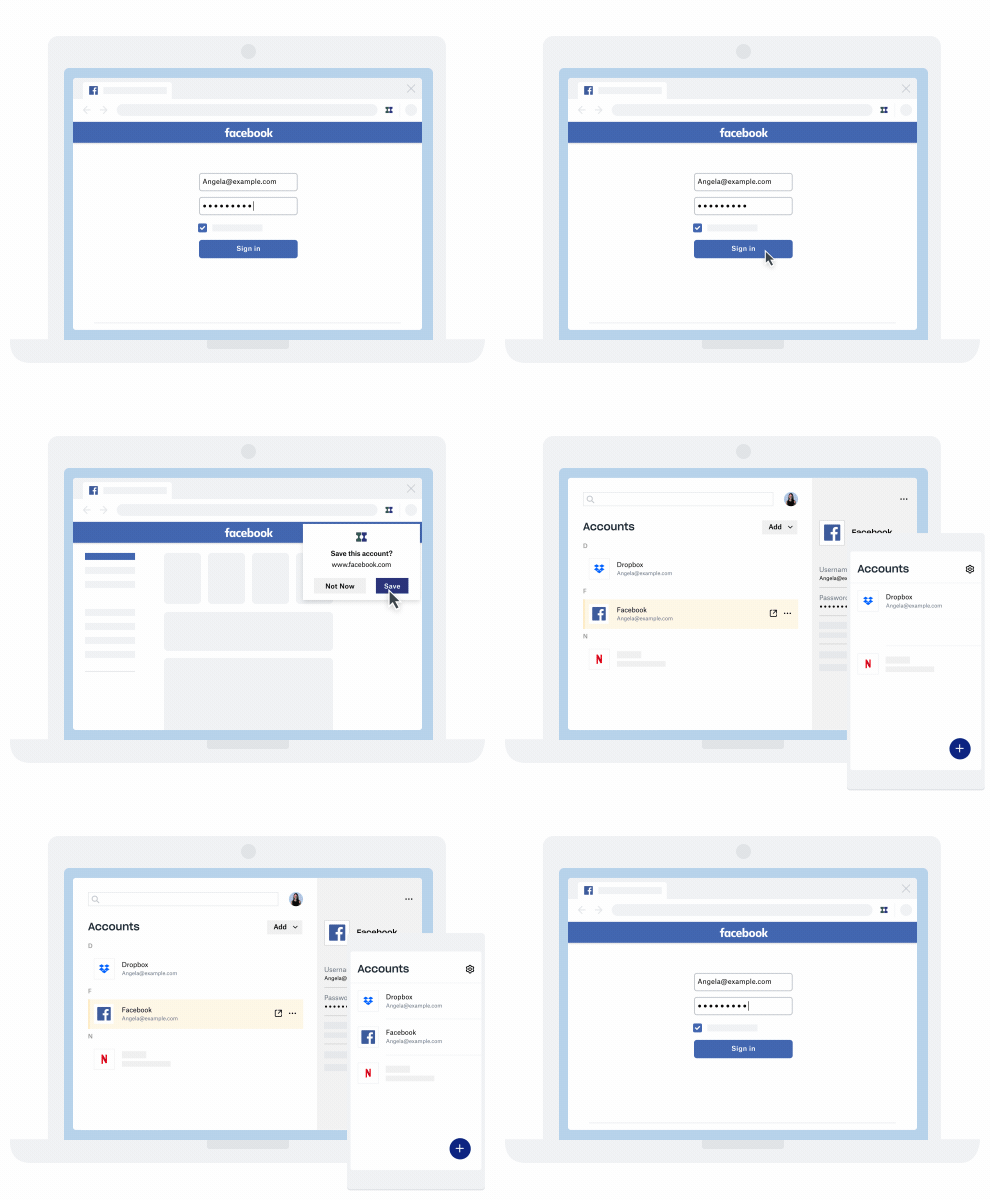
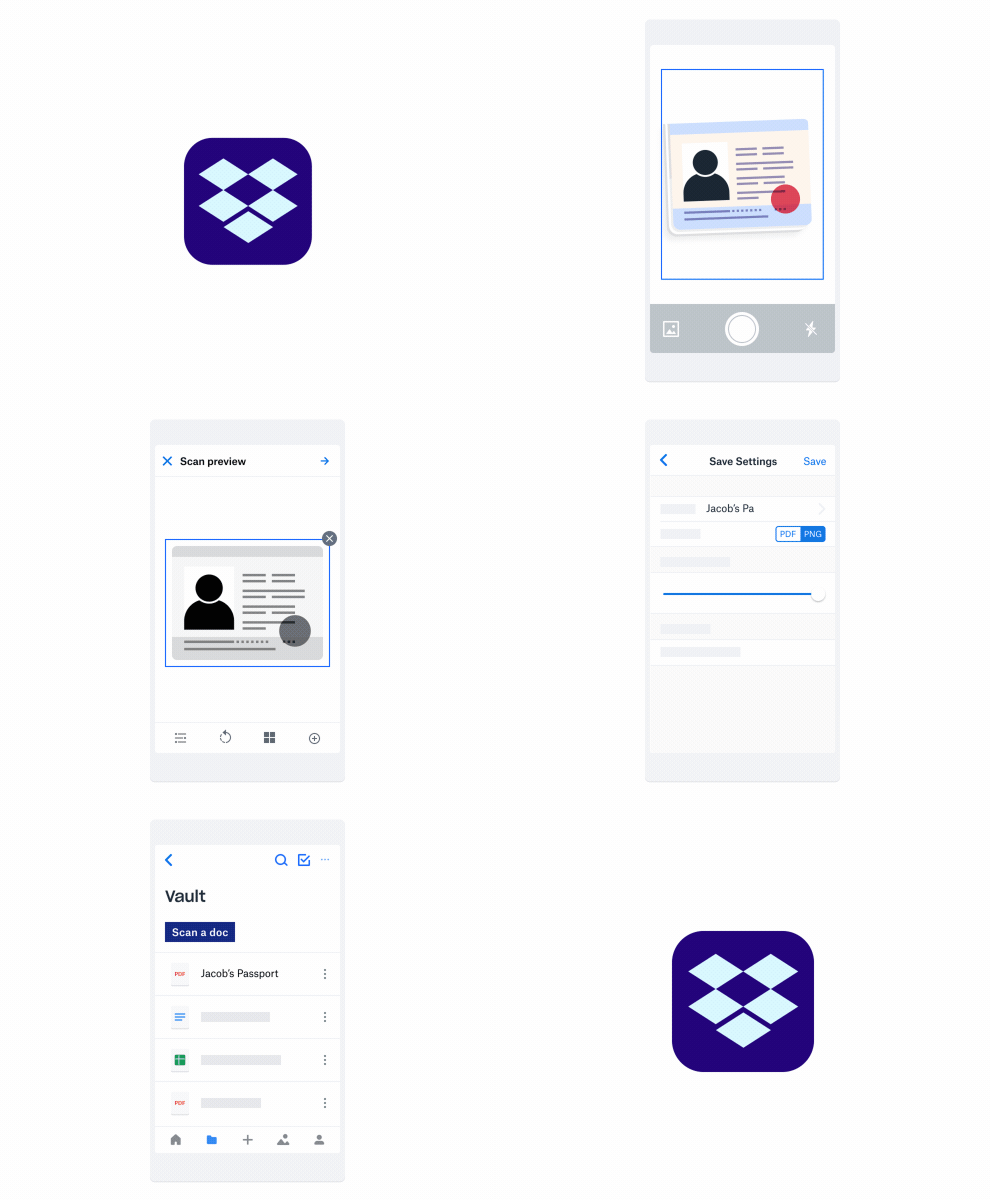
Dropbox Plus users were treated to a slew of new features today, including the company’s new password manager, PIN-protected folder, and computer backup.

In a blog post, the company announced that Dropbox Passwords, Dropbox Vault, and computer backup are no longer in beta and are now available for users on Dropbox Plus (and Professional) plans.

Dropbox Passwords uses zero-knowledge encryption so saved passwords and logins are protected and only accessible to users. When you install the browser extension or mobile app and visit a website or app with a login field, Dropbox Passwords can autofill your information, making sign-in seamless. Passwords sync across an unlimited number of devices that run Windows, Mac, iOS, or Android, and if you run Google Chrome, Firefox, or Edge on desktop, you can also import your existing passwords. The iOS and Android apps support biometric authentication (Face ID or Touch ID on iOS or fingerprint scanner on Android), and the app also automatically locks itself after a period of inactivity or when the device is locked.

Dropbox Vault provides users with a place to secure and organize sensitive documents. Using a PIN for secure access, Dropbox Vault users can store sensitive documents such as a Social Security card, bank statements, and more. Files saved in the Vault won’t appear anywhere outside of it, so they’ll remain secure even if someone gains access to your device or account (and they don’t know your PIN). Users can share these files with trusted friends and family in case of an emergency by setting them as trusted contacts. Vault can be accessed from the desktop and mobile apps for Windows, Mac, iOS, and Android or from the web at dropbox.com. The Vault is listed alongside your existing files and folders but cannot be synced to your PC’s storage.

Finally, Dropbox’s new computer backup feature will allow users to automatically back up files from folders like Desktop, Documents, and Downloads on their PCs. Users won’t need to manually drag and drop files from Finder/File Explorer into their Dropbox account. As you’d expect, these files and folders are continuously synced, so you can access them from any device, like that new computer you just got.

You can try out these new features if you’re a Dropbox Plus or Professional member. Plus plans cost $12/month or $120/year for 2TB of storage or $20/month or $200/year for 3TB of storage.

Dropbox: Cloud Storage to Backup, Sync, File Share (Free+, Google Play) →

Dropbox Passwords - Secure Password Manager (Free, Google Play) →

The post Dropbox launches its password manager, secure folder, and computer backups for Plus plans appeared first on xda-developers.


from xda-developers https://ift.tt/3kGrRE4
via IFTTT

The Xiaomi Mi 10 Ultra is the first phone with Qualcomm’s 100W+ Quick Charge 5 technology

The new Xiaomi Mi 10 Ultra is an exciting smartphone as it’s the pinnacle of 10 years of Xiaomi’s growth in the smartphone business. Featuring a 120Hz refresh rate OLED display made by TCL’s CSOT, a 48MP Quad Bayer sensor with a 120mm-equivalent, 5x optical lens for up to 120X zoom, and 120W fast wired charging, the Mi 10 Ultra is yet more proof that Xiaomi can produce innovative smartphone hardware. That last figure is one of the more exciting features of the Mi 10 Ultra as it’s actually made possible from a collaboration between Xiaomi and Qualcomm. In fact, the Mi 10 Ultra is the first smartphone to launch with Qualcomm’s new Quick Charge 5 technology.

Announced late last month, Quick Charge 5 is the latest version of Qualcomm’s fast charging technology for mobile devices. Qualcomm boasts that it is the first commercially viable fast charging platform for smartphones that supports over 100W charging power. Quick Charge 5’s charge negotiation protocol is based on the existing USB Power Delivery Programmable Power Supply (USB PD-PPS) standard, and Qualcomm’s new SMB1396 and SMB1398 PMICs support 2S battery systems (dual cell batteries connected in series.) This allows for doubling the voltage for the same current, thereby doubling the charging speed. A device with 4,500mAh in total battery capacity, for example, can charge from 0 to 50% in just five minutes (a 1.5 C-rate). If you’re wondering how Quick Charge 5 affects the longevity of a battery, Qualcomm says that the new technology uses Qualcomm’s Battery Saver algorithm and the new Qualcomm Smart Identification of Adapter Capabilities technology to support “unparalleled efficiency.”

Xiaomi Mi 10 Ultra Forums

In a blog post published on Weibo, Xiaomi further details the 120W fast charging technology in the Mi 10 Ultra. Xiaomi says the Mi 10 Ultra can be charged to 100% in just 23 minutes. They achieved this by converting two high-voltage currents of 20V/3A into two low-voltage currents of 10V/6A and then converting that to 10V/12A which is finally split among both 2,250mAh batteries connected in series. In collaboration with Qualcomm, Xiaomi says they achieved 98.5% conversion efficiency with this charging system.

In the blog post, Xiaomi also describes the changes they made to the battery and internal components to support this fast 120W charging. For example, the phone’s “butterfly double string battery” design is contrasted against traditional side-by-side dual cell battery designs, which Xiaomi says allows for a larger battery capacity without taking up more volume. The battery cells also have a “low internal resistance tab design” to reduce the resistance and temperature by 36% and 4.8°C respectively. The graphene material at the positive electrode is substantially more conductive than traditional carbon materials, the thicker and lower impedance “dual FPC connection” between the battery and motherboard reduces energy loss and heat generation, and the “Battery Sense” voltage monitoring technology accurately detects the true voltage of the battery cell to avoid errors caused by the battery protection circuit. Xiaomi says that the Mi 10 Ultra loses only 10% of its total battery capacity over 800 full charge-discharge cycles.

The Xiaomi Mi 10 Ultra is set to launch in China beginning August 16 but GSMArena reports the device won’t launch outside of the country.

The post The Xiaomi Mi 10 Ultra is the first phone with Qualcomm’s 100W+ Quick Charge 5 technology appeared first on xda-developers.


from xda-developers https://ift.tt/3gR1Srh
via IFTTT

ASUS ROG Phone II, Google Pixel 3 & 3 XL, and Samsung Galaxy A7 2016 are now supported by LineageOS 17.1

Want to breathe new life into an old phone you have lying around? Sick of the stock software experience on your phone and want to try something new? If you have an ASUS ROG Phone II, Google Pixel 3 or Pixel 3 XL, or the 2016 Samsung Galaxy A7, you can now download LineageOS 17.1, the latest version of LineageOS based on Android 10.

LineageOS has become the beloved custom ROM for many Android users, evolving from the halcyon days of CyanogenMod. While some of these phones are considered beyond their shelf life, they still have a lot of life in them once you flash a custom ROM. LineageOS 17.1 is based on Android 10 and it adds a slew of features over the previous version, including a partial screenshot UI, AOSP’s ThemePicker app, protecting apps in Trebuchet Launcher with biometrics, and more.

Google Pixel 3 and 3 XL

Google Pixel 3 Forums ||| Google Pixel 3 XL Forums

Download LineageOS 17.1 for Google Pixel 3 || Download LineageOS 17.1 for Google Pixel 3 XL

The Google Pixel 3 and Pixel 3 XL are nearly two years old, and although they’re still being supported with official updates from Google, you may be itching to try a custom ROM out to expand functionality. These builds are maintained by developers razorloves, cdesai, and intervigil. At the time of publication, the ROM for the Pixel 3 has gone live while the ROM for the Pixel 3 XL failed to build. Hopefully, the Pixel 3 XL’s build will successfully compile the next time around.

ASUS ROG Phone II

ASUS ROG Phone II Forums

Download LineageOS 17.1 for ASUS ROG Phone II

The ASUS ROG Phone II is a powerhouse that launched last year and was designed with gamers in mind. It features a massive 6,000mAh battery and 48MP camera. This build is maintained by developer OrdenKrieger with contributions from Luca020400 (who has moved on to develop for the new ASUS ROG Phone 3 following a mishap with his ROG Phone II). ASUS sent the device to both developers back in December, resulting in an unofficial build of the custom ROM becoming available in late March. The new official build joins several other mods available on our forums for the ROG Phone II.

Samsung Galaxy A7 (2016)

Samsung Galaxy A Series Forums

Download LineageOS 17.1 for Samsung Galaxy A7

The Samsung Galaxy A7 is the oldest of the four devices receiving support for LineageOS 17.1; the device was released back in 2016. Gaining support for the latest version of LineageOS will no doubt inject some new life into the Samsung device. This build is maintained by developers sourajitk, danwood76, and Stricted.

The post ASUS ROG Phone II, Google Pixel 3 & 3 XL, and Samsung Galaxy A7 2016 are now supported by LineageOS 17.1 appeared first on xda-developers.


from xda-developers https://ift.tt/2DYN8HY
via IFTTT

ASUS ROG Phone II, Google Pixel 3 & 3 XL, and Samsung Galaxy A7 2016 are now supported by LineageOS 17.1

Want to breathe new life into an old phone you have lying around? Sick of the stock software experience on your phone and want to try something new? If you have an ASUS ROG Phone II, Google Pixel 3 or Pixel 3 XL, or the 2016 Samsung Galaxy A7, you can now download LineageOS 17.1, the latest version of LineageOS based on Android 10.

LineageOS has become the beloved custom ROM for many Android users, evolving from the halcyon days of CyanogenMod. While some of these phones are considered beyond their shelf life, they still have a lot of life in them once you flash a custom ROM. LineageOS 17.1 is based on Android 10 and it adds a slew of features over the previous version, including a partial screenshot UI, AOSP’s ThemePicker app, protecting apps in Trebuchet Launcher with biometrics, and more.

Google Pixel 3 and 3 XL

Google Pixel 3 Forums ||| Google Pixel 3 XL Forums

Download LineageOS 17.1 for Google Pixel 3 || Download LineageOS 17.1 for Google Pixel 3 XL

The Google Pixel 3 and Pixel 3 XL are nearly two years old, and although they’re still being supported with official updates from Google, you may be itching to try a custom ROM out to expand functionality. These builds are maintained by developers razorloves, cdesai, and intervigil. At the time of publication, the ROM for the Pixel 3 has gone live while the ROM for the Pixel 3 XL failed to build. Hopefully, the Pixel 3 XL’s build will successfully compile the next time around.

ASUS ROG Phone II

ASUS ROG Phone II Forums

Download LineageOS 17.1 for ASUS ROG Phone II

The ASUS ROG Phone II is a powerhouse that launched last year and was designed with gamers in mind. It features a massive 6,000mAh battery and 48MP camera. This build is maintained by developer OrdenKrieger with contributions from Luca020400 (who has moved on to develop for the new ASUS ROG Phone 3 following a mishap with his ROG Phone II). ASUS sent the device to both developers back in December, resulting in an unofficial build of the custom ROM becoming available in late March. The new official build joins several other mods available on our forums for the ROG Phone II.

Samsung Galaxy A7 (2016)

Samsung Galaxy A Series Forums

Download LineageOS 17.1 for Samsung Galaxy A7

The Samsung Galaxy A7 is the oldest of the four devices receiving support for LineageOS 17.1; the device was released back in 2016. Gaining support for the latest version of LineageOS will no doubt inject some new life into the Samsung device. This build is maintained by developers sourajitk, danwood76, and Stricted.

The post ASUS ROG Phone II, Google Pixel 3 & 3 XL, and Samsung Galaxy A7 2016 are now supported by LineageOS 17.1 appeared first on xda-developers.


from xda-developers https://ift.tt/2DYN8HY
via IFTTT