LightBlog

lundi 10 août 2020

Amazon will rebrand Twitch Prime to Prime Gaming, in line with other Amazon products like Prime Music and Prime Video

Amazon acquired Twitch, the video live streaming service, back in August 2014. Twitch has flourished since then and continues to be a market leader in the realm of video game live streaming despite competition from YouTube. Back in September 2016, Twitch had announced Twitch Prime, a service that provided premium features to Amazon Prime subscribers. These premium features included ad-free streaming, free add-on content, and even game discounts. Now, news has emerged that Amazon might finally look to rebrand Twitch Prime to Prime Gaming, bringing its branding inline with other Amazon products and services such as Prime Video and Prime Music.

According to an email sent by Twitch to its partners, and as accessed by industry insider Rod ‘Slasher’ Breslau, Twitch and Amazon will be rebranding Twitch Prime to Prime Gaming to “make it clearer” to members, and bring the service branding in line with other Amazon products such as Prime Music and Prime Video.

After four years, Twitch Prime will be rebranding to Prime Gaming to make it clearer for Prime Gaming members to discover all the gaming benefits their membership offers, including must-have content for the world’s most played games, and free monthly subscriptions to help you grow your audience from the millions of worldwide Amazon Prime members.

So what does that mean for you? More opportunities!

It means more chances to grow your viewership across all types of gamers from the Amazon Prime member base and opportunities to be featured in future Prime Gaming promotions.

Apart from the rebranding, there does not appear to be any other real change. With this, all the services that are available under Amazon Prime membership will be self-explanatory to new subscribers. Prime Gaming would thus co-exist alongside Prime Video and Prime Music in selected regions, along with the options of free and fast shipping from Amazon under the Prime membership.


Source: Slasher

The post Amazon will rebrand Twitch Prime to Prime Gaming, in line with other Amazon products like Prime Music and Prime Video appeared first on xda-developers.


from xda-developers https://ift.tt/31zwGq4
via IFTTT

Qualcomm reportedly wants to sell its 5G Snapdragon chips to Huawei

Last week, Huawei dropped an ominous announcement that the Huawei Mate 40 will likely be the last smartphone with a HiSilicon Kirin chip. Contract chipmakers have been barred from using US-developed tech to fabricate chips for Huawei after September 15, 2020, thus effectively barring TSMC from fabricating Kirin chipsets. Now, it appears that Qualcomm is lobbying for a license to sell its 5G Snapdragon SoCs to Huawei for use in its flagships and other lineups.

According to a report from the Wall Street Journal, US-based Qualcomm is lobbying the Trump administration to roll back restrictions on the sale of advanced components to Huawei. Qualcomm presents that the export ban will not stop Huawei from obtaining necessary components, and instead, it will hand over billions of dollars of Huawei sales to other competitors. Qualcomm presented Huawei as a customer for $8 billion worth of orders. And because of the license requirements upon US firms, this business now potentially goes to “two foreign competitors”, referring to Taiwan’s MediaTek and South Korea’s Samsung. Denying Qualcomm a license will help Qualcomm’s foreign competitors while hardly affecting Huawei as it can source components elsewhere. Granting a license would generate billions of dollars in sales for Qualcomm and help it fund development fo new technologies, Qualcomm argued.

If Qualcomm is allowed to sell chips to Huawei, it can fill in the large shoes needed in the absence of a Kirin flagship. The next generation of Kirin SoCs to be used in the Huawei Mate 40 have already been fabricated, but flagships and other lineups beyond are now in a limbo. Huawei is already experimenting with high-end MediaTek Dimensity chipsets in a few devices, so that could be the direction for the future. The Snapdragon flagships offer the best performance in the Android space, so it remains to be seen how the situation unfolds if Qualcomm is allowed to sell to Huawei.


Source: Wall Street Journal

The post Qualcomm reportedly wants to sell its 5G Snapdragon chips to Huawei appeared first on xda-developers.


from xda-developers https://ift.tt/2XIUoz2
via IFTTT

Qualcomm reportedly wants to sell its 5G Snapdragon chips to Huawei

Last week, Huawei dropped an ominous announcement that the Huawei Mate 40 will likely be the last smartphone with a HiSilicon Kirin chip. Contract chipmakers have been barred from using US-developed tech to fabricate chips for Huawei after September 15, 2020, thus effectively barring TSMC from fabricating Kirin chipsets. Now, it appears that Qualcomm is lobbying for a license to sell its 5G Snapdragon SoCs to Huawei for use in its flagships and other lineups.

According to a report from the Wall Street Journal, US-based Qualcomm is lobbying the Trump administration to roll back restrictions on the sale of advanced components to Huawei. Qualcomm presents that the export ban will not stop Huawei from obtaining necessary components, and instead, it will hand over billions of dollars of Huawei sales to other competitors. Qualcomm presented Huawei as a customer for $8 billion worth of orders. And because of the license requirements upon US firms, this business now potentially goes to “two foreign competitors”, referring to Taiwan’s MediaTek and South Korea’s Samsung. Denying Qualcomm a license will help Qualcomm’s foreign competitors while hardly affecting Huawei as it can source components elsewhere. Granting a license would generate billions of dollars in sales for Qualcomm and help it fund development fo new technologies, Qualcomm argued.

If Qualcomm is allowed to sell chips to Huawei, it can fill in the large shoes needed in the absence of a Kirin flagship. The next generation of Kirin SoCs to be used in the Huawei Mate 40 have already been fabricated, but flagships and other lineups beyond are now in a limbo. Huawei is already experimenting with high-end MediaTek Dimensity chipsets in a few devices, so that could be the direction for the future. The Snapdragon flagships offer the best performance in the Android space, so it remains to be seen how the situation unfolds if Qualcomm is allowed to sell to Huawei.


Source: Wall Street Journal

The post Qualcomm reportedly wants to sell its 5G Snapdragon chips to Huawei appeared first on xda-developers.


from xda-developers https://ift.tt/2XIUoz2
via IFTTT

OPPO Reno4 Z 5G and OPPO Reno4 Lite get certified for a possible global launch

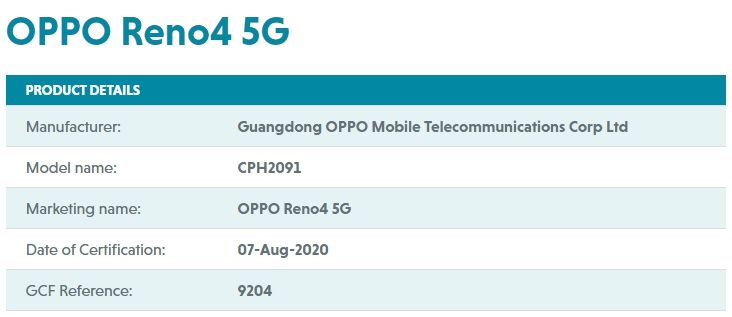
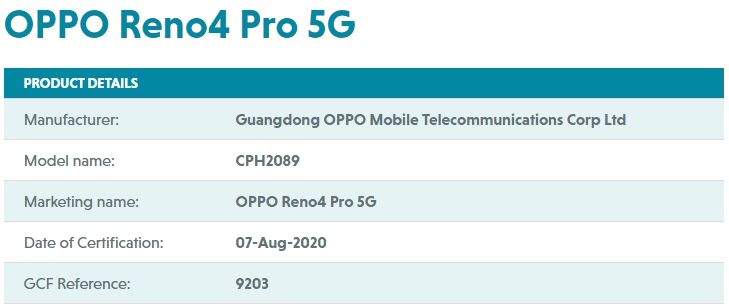
Following the launch of the Snapdragon 720G powered Reno4 Pro (global) late last month, Chinese OEM OPPO is now gearing up to launch the 5G-enabled Reno4 (CPH2091) and Reno4 Pro (CPH2089) globally. The Snapdragon 765G powered mid-range devices, which were launched in China earlier this year in June, recently received Global Certification Forum (GCF) certification. This leads us to believe that the device will be launched in global markets in the coming weeks.

OPPO Reno4 Pro 5G

Along with the Reno4 5G and Reno4 Pro 5G, OPPO has also filed for certification for two new Reno4 series devices — the OPPO Reno4 Z 5G (CPH2065) and the OPPO Reno4 Lite (CPH2125). Certification filing for Reno4 Z 5G (CPH2065) has been spotted on the FCC, with the listing showcasing the design of the back panel.

OPPO Reno4 Z

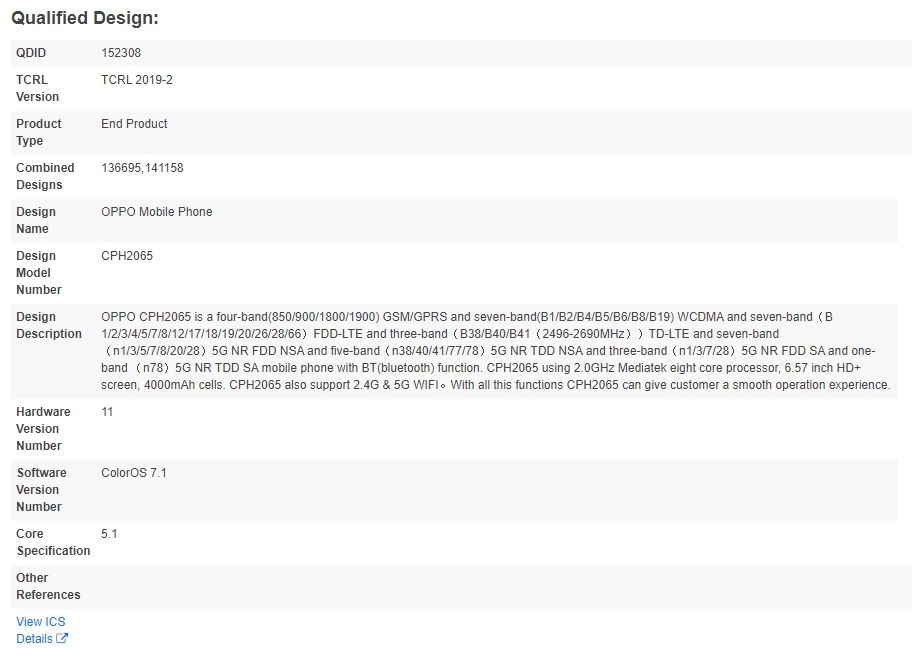
A Bluetooth SIG filing for CPH2065 reveals that the device will feature a 6.57-inch HD+ display, a 4,000mAh battery, a 2.0GHz MediaTek octa-core processor, and it’ll run ColorOS 7.1 based on Android 10. Considering the given specifications, we believe that the Reno4 Z 5G will be powered by a low-end MediaTek Dimensity 5G chipset.

OPPO Reno4 Z

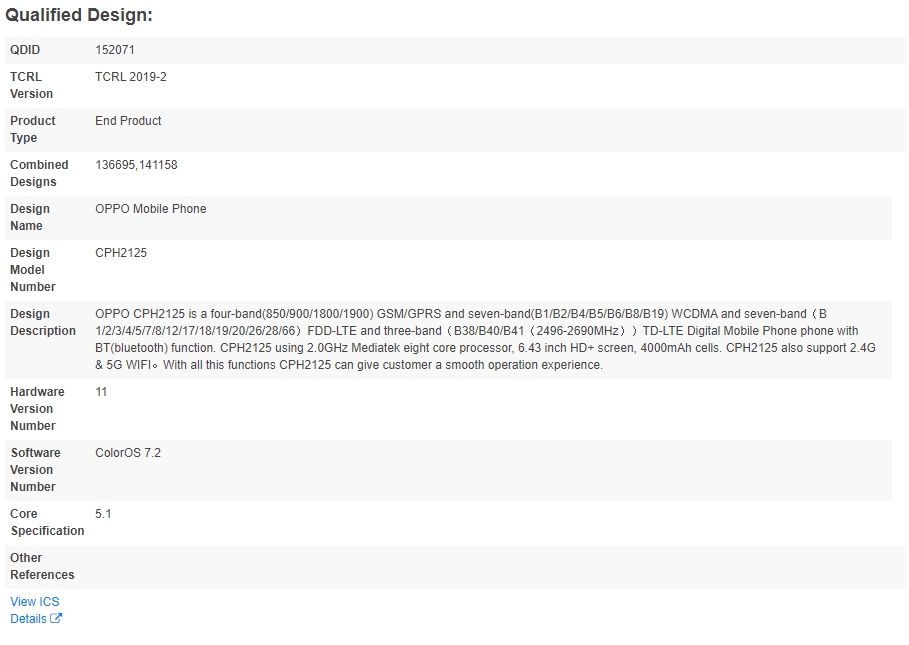
The OPPO Reno4 Lite (CPH2125) has also been spotted in a Bluetooth SIG filing, which reveals that the device will feature a 6.43-inch HD+ display, a 4,000mAh battery, a 2.0GHz MediaTek octa-core processor, and it’ll run ColorOS 7.2 based on Android 10.

Another device with the model number CPH2123 has been spotted on the FCC website, which might be a variant of the upcoming Reno4 Lite. The FCC listing doesn’t reveal much about CPH2123, but it does specify that the device doesn’t have 5G band certification. The Reno4 Lite will, most likely, feature a higher-end MediaTek Helio chipset. As of now, OPPO hasn’t released any official information about the devices mentioned above. We expect to learn more from the company in the following weeks.


Source: GCF (1,2), FCCID (1,2,3), Bluetooth SIG (1,2)

Featured image: OPPO Reno4

The post OPPO Reno4 Z 5G and OPPO Reno4 Lite get certified for a possible global launch appeared first on xda-developers.


from xda-developers https://ift.tt/3krWay1
via IFTTT

OPPO Reno4 Z 5G and OPPO Reno4 Lite get certified for a possible global launch

Following the launch of the Snapdragon 720G powered Reno4 Pro (global) late last month, Chinese OEM OPPO is now gearing up to launch the 5G-enabled Reno4 (CPH2091) and Reno4 Pro (CPH2089) globally. The Snapdragon 765G powered mid-range devices, which were launched in China earlier this year in June, recently received Global Certification Forum (GCF) certification. This leads us to believe that the device will be launched in global markets in the coming weeks.

OPPO Reno4 Pro 5G

Along with the Reno4 5G and Reno4 Pro 5G, OPPO has also filed for certification for two new Reno4 series devices — the OPPO Reno4 Z 5G (CPH2065) and the OPPO Reno4 Lite (CPH2125). Certification filing for Reno4 Z 5G (CPH2065) has been spotted on the FCC, with the listing showcasing the design of the back panel.

OPPO Reno4 Z

A Bluetooth SIG filing for CPH2065 reveals that the device will feature a 6.57-inch HD+ display, a 4,000mAh battery, a 2.0GHz MediaTek octa-core processor, and it’ll run ColorOS 7.1 based on Android 10. Considering the given specifications, we believe that the Reno4 Z 5G will be powered by a low-end MediaTek Dimensity 5G chipset.

OPPO Reno4 Z

The OPPO Reno4 Lite (CPH2125) has also been spotted in a Bluetooth SIG filing, which reveals that the device will feature a 6.43-inch HD+ display, a 4,000mAh battery, a 2.0GHz MediaTek octa-core processor, and it’ll run ColorOS 7.2 based on Android 10.

Another device with the model number CPH2123 has been spotted on the FCC website, which might be a variant of the upcoming Reno4 Lite. The FCC listing doesn’t reveal much about CPH2123, but it does specify that the device doesn’t have 5G band certification. The Reno4 Lite will, most likely, feature a higher-end MediaTek Helio chipset. As of now, OPPO hasn’t released any official information about the devices mentioned above. We expect to learn more from the company in the following weeks.


Source: GCF (1,2), FCCID (1,2,3), Bluetooth SIG (1,2)

Featured image: OPPO Reno4

The post OPPO Reno4 Z 5G and OPPO Reno4 Lite get certified for a possible global launch appeared first on xda-developers.


from xda-developers https://ift.tt/3krWay1
via IFTTT

Gboard rolls out smart completion and undo autocorrect on backspace, tests new Google Assistant dictation

In a recent teardown of Gboard v9.7, we discovered strings of code regarding a couple of new features making their way to the popular keyboard app. These included a new Ask Assistant button to trigger the Google Assistant, smart completion support, and a feature that would undo auto-correct on tapping backspace. Now, Google has started rolling out some of these features in the latest stable release of the Gboard app.

Gboard v9.7.03 has started rolling out on the stable channel and it brings smart completion support to the app, along with a new undo auto-correct on backspace toggle. Our Editor-in-Chief, Mishaal Rahman, has shared the following screenshots of the new features in action.

As you can see in the attached screenshots, there’s a new ‘Smart completions’ toggle in Gboard settings that you can enable to turn on the new feature. Much like the Smart Compose feature on Gmail and Google Docs, Smart completions in Gboard makes use of machine learning to provide suggestions to help you complete a sentence. The suggestions appear right next to whatever you’re typing in the text box and you can swipe right across the suggested sentence to autocomplete it.

Along with the Smart completions feature, the Gboard update also brings an ‘Undo auto-correct on backspace’ setting. Once enabled, the setting will let you easily revert back to the original text by tapping the backspace key when Gboard’s autocorrect messes up.

Additionally, Gboard has also started testing a new Google Assistant-powered dictation feature which was first showcased at Google I/O 2019. Strings related to the feature were spotted in a recent teardown of Gboard v9.6.3 beta and it now seems to be rolling out to a few users. While the feature wasn’t available on any of our devices, @TotalSecurily on Twitter has shared the following clip of the feature in action.

As you can see in the clip, tapping on the mic icon in Gboard brings up a new Google Assistant dictation interface that lets you enter text using just your voice. The feature also lets you send the message by saying send or delete whatever is typed out by saying delete. Once you’re done using the feature, you can also close it by simply saying close.

All of the new features mentioned above seem to be a part of a server-side test and they’re only available for a handful of users at the moment. While Google hasn’t released any information regarding a wider rollout, we expect the new features to reach all users in the following weeks.

The post Gboard rolls out smart completion and undo autocorrect on backspace, tests new Google Assistant dictation appeared first on xda-developers.


from xda-developers https://ift.tt/33PAbLP
via IFTTT

Gboard rolls out smart completion and undo autocorrect on backspace, tests new Google Assistant dictation

In a recent teardown of Gboard v9.7, we discovered strings of code regarding a couple of new features making their way to the popular keyboard app. These included a new Ask Assistant button to trigger the Google Assistant, smart completion support, and a feature that would undo auto-correct on tapping backspace. Now, Google has started rolling out some of these features in the latest stable release of the Gboard app.

Gboard v9.7.03 has started rolling out on the stable channel and it brings smart completion support to the app, along with a new undo auto-correct on backspace toggle. Our Editor-in-Chief, Mishaal Rahman, has shared the following screenshots of the new features in action.

As you can see in the attached screenshots, there’s a new ‘Smart completions’ toggle in Gboard settings that you can enable to turn on the new feature. Much like the Smart Compose feature on Gmail and Google Docs, Smart completions in Gboard makes use of machine learning to provide suggestions to help you complete a sentence. The suggestions appear right next to whatever you’re typing in the text box and you can swipe right across the suggested sentence to autocomplete it.

Along with the Smart completions feature, the Gboard update also brings an ‘Undo auto-correct on backspace’ setting. Once enabled, the setting will let you easily revert back to the original text by tapping the backspace key when Gboard’s autocorrect messes up.

Additionally, Gboard has also started testing a new Google Assistant-powered dictation feature which was first showcased at Google I/O 2019. Strings related to the feature were spotted in a recent teardown of Gboard v9.6.3 beta and it now seems to be rolling out to a few users. While the feature wasn’t available on any of our devices, @TotalSecurily on Twitter has shared the following clip of the feature in action.

As you can see in the clip, tapping on the mic icon in Gboard brings up a new Google Assistant dictation interface that lets you enter text using just your voice. The feature also lets you send the message by saying send or delete whatever is typed out by saying delete. Once you’re done using the feature, you can also close it by simply saying close.

All of the new features mentioned above seem to be a part of a server-side test and they’re only available for a handful of users at the moment. While Google hasn’t released any information regarding a wider rollout, we expect the new features to reach all users in the following weeks.

The post Gboard rolls out smart completion and undo autocorrect on backspace, tests new Google Assistant dictation appeared first on xda-developers.


from xda-developers https://ift.tt/33PAbLP
via IFTTT