LightBlog

vendredi 7 août 2020

7 JavaScript and Java Courses That Are on Sale This Week

Although Java and JavaScript are very different languages, they make a great tag team. Master them both and you will be able to build amazing Android apps and websites from scratch. To help you get started, here are seven great deals on premium courses at the XDA Developers Depot. 

The 2020 Java Bootcamp Bundle

Perfect for first-time developers, this bundle includes 10 beginner-friendly courses with an average rating of 4.6 stars. Through 10 hours of content, you learn how to build working programs using objects, arrays, collections, and more. The training is worth $990, but you can grab the bundle now for $36.

The 2020 Complete Java Master Class Bundle

Taking you to the next level, this collection of seven courses helps you thrive as a Java developer. In 62 hours of training, you discover how to code native apps for Android and rich web applications, using a range of popular tools. Normally valued at $1,066, these courses are now only $33.99.

The Complete Full-Stack JavaScript Course

Covering both frontend and backend development, this course helps you master JavaScript for the web. You get 21 hours of training in total, covering ReactJS, NodeJS, LoopbackJS, Redux, Material-UI, and more. The course also includes three exciting projects. Normally priced at $200, it’s now only $28.

Oracle Java Certification Exam Preparation Courses + Tests Training Bundle
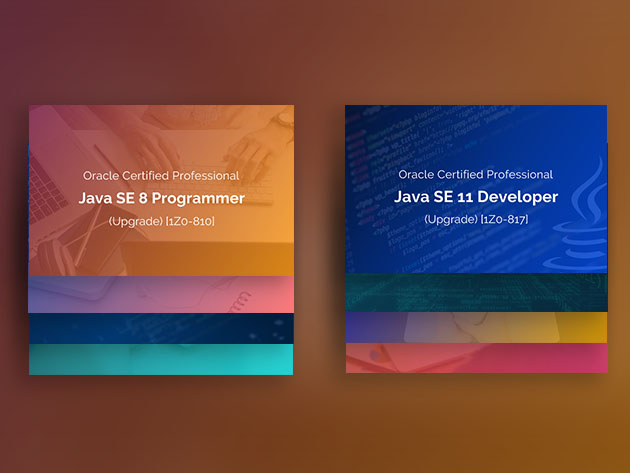
According to PayScale, Oracle Java Certified developers can earn up to $120k a year. This bundle helps you pass the test, with 13 hours of training videos, 40 full-length mock exams, and exhaustive explanations of every question. Worth $400 in total, this bundle is now only $29.99

The Complete JavaScript eBook Bundle

If you would like to explore the full potential of JavaScript, this mini-library of ebooks is a great place to start. The bundle includes ten titles, covering basic JS along with fascinating topics such as enterprise development, machine learning, 3D graphics, the Internet of Things, and much more. The ebooks retail for a total of $400, but you can get them now for $19.99.

The Ultimate Java Expert Certification Bundle

With 11 courses and 38 hours of content, this Ultimate Bundle lives up to its name. The training covers the latest features in Java 9, shows you how to build web applications, and even looks at UI design. Just as importantly, you should come away with certificates and a nice portfolio. Usually valued at $2,200, these courses are now only $31.

The Comprehensive JavaScript Bundle

From developing games to creating dynamic web pages, this bundle helps you master JavaScript through 142 hours of video lessons. Along with the fundamentals, you learn about JavaScript DOM, HTML5 canvas drawing, object-oriented programming, and more. The eight courses are worth $1,492, but you can get them now for $31.

Prices subject to change 

The post 7 JavaScript and Java Courses That Are on Sale This Week appeared first on xda-developers.


from xda-developers https://ift.tt/2XEJSsl
via IFTTT

Download: OnePlus 7/7T series gets OxygenOS Open Beta 17/7 with August 2020 security patches and bug fixes

OnePlus recently announced a revision to the frequency of OxygenOS Open Beta update rollouts. To improve the stability of their public beta builds, the company is going to reduce the frequency of Open Beta updates to a single OTA per month instead of 2 (or more, considering hotfixes). In accordance with the new strategy, OnePlus had rolled out an open beta build in June and July. And for the new month of August, we have a new set of Open Beta builds that bring over August 2020 security patches and a bunch of bug fixes.

The update bumps the Android security patch level (SPL) to August 2020 and includes several fixes and optimizations. The update also includes a new user assistance feature, which includes tips on how to use the phone. This is present at Settings > OnePlus Tips & Help.

The complete changelog for the Open Beta 17 and Open Beta 7 update for the OnePlus 7 series and OnePlus 7T series can be found below:

  • System
    • Newly added user assistance feature to help user master usage skills quickly(Route: Settings>OnePlus Tips&Help)
    • Fixed the abnormal error occurred in Lockbox
    • Fixed the auto-start issue with QXDM logs after reboot
    • Optimized user experience with long screenshot in some scenarios
    • Updated Android security patch to 2020.08
  • Messages
    • Optimized the categorization, messages of the same contact now merged in one card(India only)
  • File Manager
    • Fixed the issue that File Manager did not display some downloaded documents of apps
  • Network
    • Improved the stability of Wi-Fi transfers

Download OxygenOS Open Beta 17/7 for the OnePlus 7/7T series

OnePlus 7

OnePlus 7 Pro

OnePlus 7T

OnePlus 7T Pro


Thanks to XDA Senior Member Some_Random_Username for the download links!

The post Download: OnePlus 7/7T series gets OxygenOS Open Beta 17/7 with August 2020 security patches and bug fixes appeared first on xda-developers.


from xda-developers https://ift.tt/33xP6Kp
via IFTTT

Download: OnePlus 7/7T series gets OxygenOS Open Beta 17/7 with August 2020 security patches and bug fixes

OnePlus recently announced a revision to the frequency of OxygenOS Open Beta update rollouts. To improve the stability of their public beta builds, the company is going to reduce the frequency of Open Beta updates to a single OTA per month instead of 2 (or more, considering hotfixes). In accordance with the new strategy, OnePlus had rolled out an open beta build in June and July. And for the new month of August, we have a new set of Open Beta builds that bring over August 2020 security patches and a bunch of bug fixes.

The update bumps the Android security patch level (SPL) to August 2020 and includes several fixes and optimizations. The update also includes a new user assistance feature, which includes tips on how to use the phone. This is present at Settings > OnePlus Tips & Help.

The complete changelog for the Open Beta 17 and Open Beta 7 update for the OnePlus 7 series and OnePlus 7T series can be found below:

  • System
    • Newly added user assistance feature to help user master usage skills quickly(Route: Settings>OnePlus Tips&Help)
    • Fixed the abnormal error occurred in Lockbox
    • Fixed the auto-start issue with QXDM logs after reboot
    • Optimized user experience with long screenshot in some scenarios
    • Updated Android security patch to 2020.08
  • Messages
    • Optimized the categorization, messages of the same contact now merged in one card(India only)
  • File Manager
    • Fixed the issue that File Manager did not display some downloaded documents of apps
  • Network
    • Improved the stability of Wi-Fi transfers

Download OxygenOS Open Beta 17/7 for the OnePlus 7/7T series

OnePlus 7

OnePlus 7 Pro

OnePlus 7T

OnePlus 7T Pro


Thanks to XDA Senior Member Some_Random_Username for the download links!

The post Download: OnePlus 7/7T series gets OxygenOS Open Beta 17/7 with August 2020 security patches and bug fixes appeared first on xda-developers.


from xda-developers https://ift.tt/33xP6Kp
via IFTTT

TWRP adds support for the Motorola One Vision, Realme C2, LG V20, and more

Last month, we saw the official TWRP builds making their way to the Samsung Galaxy M20, Asus ZenFone 5Z, Redmi 6/6A, Galaxy S4 Mini, and more. Since then, some more devices have been added to the TWRP build roaster, including the Moto One Action, Realme C2, LG V20, Lenovo Smart Tab M10, Huawei P9 Lite (hi6250), and Ergo Force F500.

Moto One Vision

The Moto One Vision is a lower mid-range Android One phone from Motorola, offering a tall 21:9 display, Exynos 96109 SoC, a 48MP primary camera, and a near-stock Android 10 experience. There was already an unofficial build of TWRP maintained by XDA Senior Member tys0n. However, this official build is supported by kaneawk, a well-known name among the Motorola community, who also manages several other Motorola devices, including the Moto X4, Moto X Force, Moto G6 Plus, Moto Z3 Play, and so on.

Motorola One Vision TWRP || Motorola One Vision XDA Forums

Realme C2

After the Realme 5 Pro, Realme X2 Pro, and Realme 6 Pro, the Realme C2 has become the latest to receive the official TWRP build. Although there doesn’t appear to be any working ports of custom ROMs available for the Realme C2 owners to try out, the release of TWRP will hopefully help kickstart the development scene.

Realme C2 TWRP || Realme C2 XDA Forums

LG V20

LG V20 owners with an unlocked bootloader can also dip their toes into the world of custom ROMs and modding, thanks to the availability of official TWRP build. Apart from the unlocked and global variants, those holding onto carrier models will also be able to flash the custom recovery, all thanks to XDA Senior Member npjohnson.

LG V20 XDA Forums

TWRP builds:

Lenovo Smart Tab M10

The Lenovo Smart Tab M10 is an Android-powered tablet, offering a 10.1-inch full HD display, Snapdragon 450 SoC, up to 3GB RAM, a 5MP rear camera, dual Dolby speakers, and a 4850 mAh battery. The tablet comes running Android Oreo out-of-the-box. The TWRP build for Lenovo Smart Tab M10 is maintained by XDA Senior Member Yahoo Mike and can be downloaded from the link given below.

Lenovo Smart Tab M10 TWRP

Huawei P9 Lite (hi6250)

The Huawei P9 Lite (hi6250) was announced all the way back in 2016 with a 5.2-inch FullHD display, HiSilicon Kirin 650 SoC, 2GB/3GB RAM, and a 3,000 mAh battery. While an unofficial build of TWRP has existed since 2017, it’s only now that the device has bee added to the TWRP build roaster.

Huawei P9 Lite (hi6250) TWRP || Huawei P9 Lite XDA Forums

These builds should also work on other Huawei and Honor devices with the HiSilicon Kirin 650 SoC running EMUI 5 based on Android 7.0 Nougat.

Ergo Force F500

Finally, the Ergo Force F500, an entry-level smartphone from a lesser-known smartphone brand called TM Ergo, has also received the official TWRP support. Visit the link given below to download the recovery zip and follow along with the step-by-step flashing instruction.

Ergo Force F500 TWRP

The post TWRP adds support for the Motorola One Vision, Realme C2, LG V20, and more appeared first on xda-developers.


from xda-developers https://ift.tt/2DxoyhJ
via IFTTT

TWRP adds support for the Motorola One Vision, Realme C2, LG V20, and more

Last month, we saw the official TWRP builds making their way to the Samsung Galaxy M20, Asus ZenFone 5Z, Redmi 6/6A, Galaxy S4 Mini, and more. Since then, some more devices have been added to the TWRP build roaster, including the Moto One Action, Realme C2, LG V20, Lenovo Smart Tab M10, Huawei P9 Lite (hi6250), and Ergo Force F500.

Moto One Vision

The Moto One Vision is a lower mid-range Android One phone from Motorola, offering a tall 21:9 display, Exynos 96109 SoC, a 48MP primary camera, and a near-stock Android 10 experience. There was already an unofficial build of TWRP maintained by XDA Senior Member tys0n. However, this official build is supported by kaneawk, a well-known name among the Motorola community, who also manages several other Motorola devices, including the Moto X4, Moto X Force, Moto G6 Plus, Moto Z3 Play, and so on.

Motorola One Vision TWRP || Motorola One Vision XDA Forums

Realme C2

After the Realme 5 Pro, Realme X2 Pro, and Realme 6 Pro, the Realme C2 has become the latest to receive the official TWRP build. Although there doesn’t appear to be any working ports of custom ROMs available for the Realme C2 owners to try out, the release of TWRP will hopefully help kickstart the development scene.

Realme C2 TWRP || Realme C2 XDA Forums

LG V20

LG V20 owners with an unlocked bootloader can also dip their toes into the world of custom ROMs and modding, thanks to the availability of official TWRP build. Apart from the unlocked and global variants, those holding onto carrier models will also be able to flash the custom recovery, all thanks to XDA Senior Member npjohnson.

LG V20 XDA Forums

TWRP builds:

Lenovo Smart Tab M10

The Lenovo Smart Tab M10 is an Android-powered tablet, offering a 10.1-inch full HD display, Snapdragon 450 SoC, up to 3GB RAM, a 5MP rear camera, dual Dolby speakers, and a 4850 mAh battery. The tablet comes running Android Oreo out-of-the-box. The TWRP build for Lenovo Smart Tab M10 is maintained by XDA Senior Member Yahoo Mike and can be downloaded from the link given below.

Lenovo Smart Tab M10 TWRP

Huawei P9 Lite (hi6250)

The Huawei P9 Lite (hi6250) was announced all the way back in 2016 with a 5.2-inch FullHD display, HiSilicon Kirin 650 SoC, 2GB/3GB RAM, and a 3,000 mAh battery. While an unofficial build of TWRP has existed since 2017, it’s only now that the device has bee added to the TWRP build roaster.

Huawei P9 Lite (hi6250) TWRP || Huawei P9 Lite XDA Forums

These builds should also work on other Huawei and Honor devices with the HiSilicon Kirin 650 SoC running EMUI 5 based on Android 7.0 Nougat.

Ergo Force F500

Finally, the Ergo Force F500, an entry-level smartphone from a lesser-known smartphone brand called TM Ergo, has also received the official TWRP support. Visit the link given below to download the recovery zip and follow along with the step-by-step flashing instruction.

Ergo Force F500 TWRP

The post TWRP adds support for the Motorola One Vision, Realme C2, LG V20, and more appeared first on xda-developers.


from xda-developers https://ift.tt/2DxoyhJ
via IFTTT

Google’s Digital Ink Recognition API in ML Kit enables handwriting and drawing recognition

About a month ago, Google made some significant changes to its ML Kit SDK (Software Development Kit) to make mobile development with machine learning easier for developers. The company decoupled ML Kit’s on-device APIs from Firebase and made them available under a separate SDK, added Android Jetpack Lifecycle support to all APIs, and announced an early access program to give developers access to upcoming APIs and features. Now, the company has launched the Digital Ink Recognition API on Android and iOS, to allow developers to create apps in which stylus and touch act as inputs.

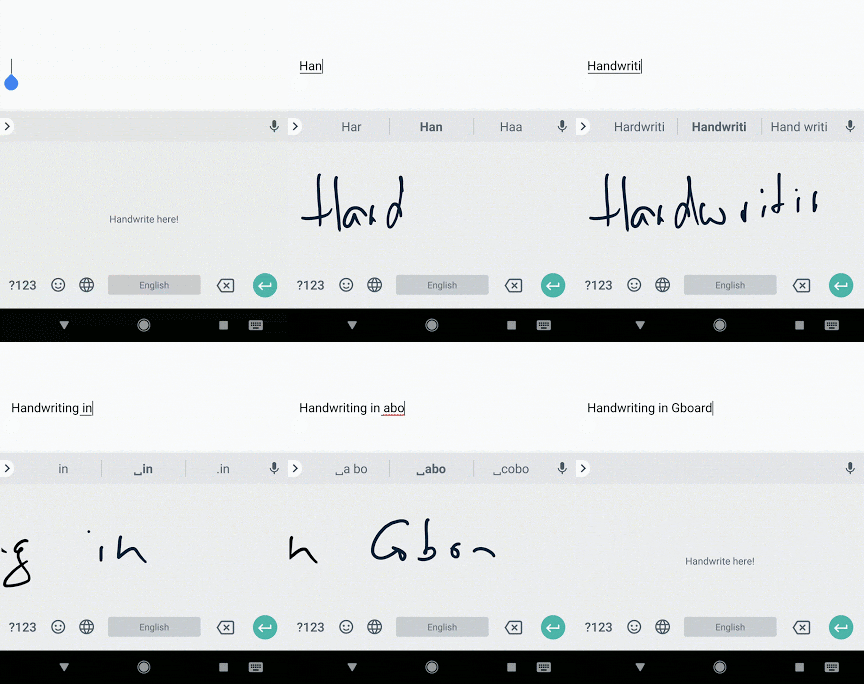
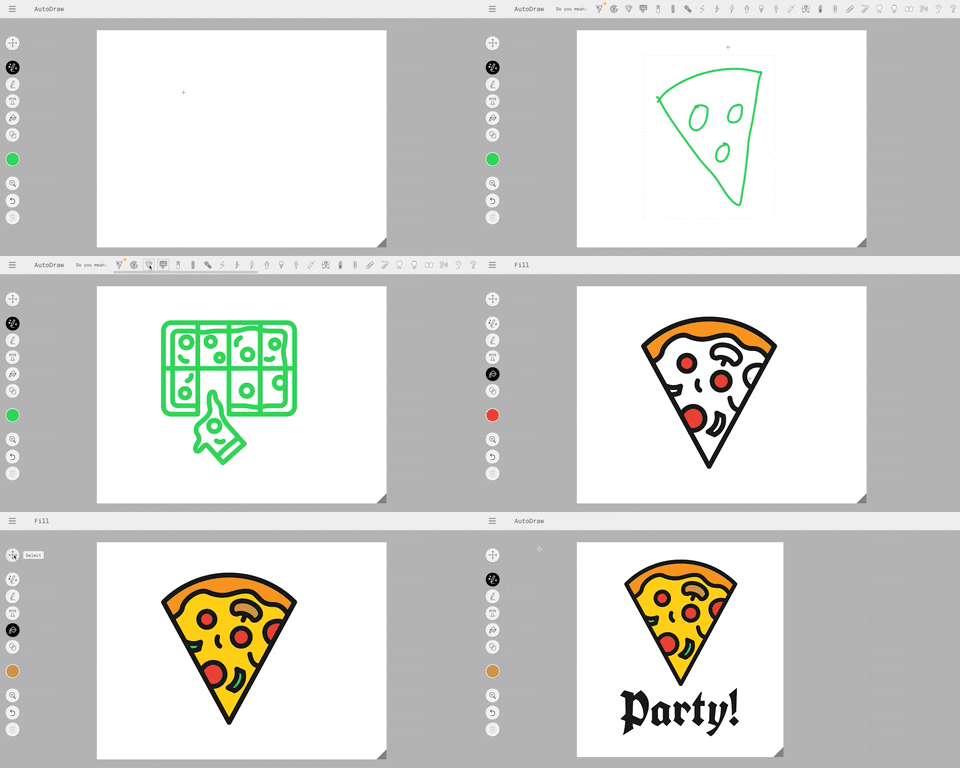
According to Google’s blog post on the matter, the Digital Ink Recognition API is capable of identifying stylus/touch input on a screen and recognizing what’s being written. The API makes use of the same technology that powers handwriting recognition on the Gboard app, and Google’s Quick, Draw! and AutoDraw experiments.

With the addition of the Digital Ink Recognition API, developers will now be able to implement this technology in their apps, “for everything from letting users input text and figures with a finger or stylus to transcribing handwritten notes to make them searchable; all in near real time and entirely on device.” Currently, the Digital Ink Recognition API supports over 300 languages and over 25 writing systems, including all major Latin languages, Chinese, Japanese, Korean, Arabic, Cyrillic, and more.

Along with handwriting, the API will also be able to recognize shapes and it currently supports an autodraw sketch recognizer, an emoji recognizer, and a basic shape recognizer. And Google claims that the API will be able to do this all without an active internet connection. However, it will require users to download one or more models before they can use a recognizer.

If you’re interested in adding handwriting or shape recognition features to your Android app using the new Digital Ink Recognition API, you can follow this link to check out all the related documentation. In case you want to see the API in action, you can check out these sample apps for Android and iOS.


Source: Google Developers blog

The post Google’s Digital Ink Recognition API in ML Kit enables handwriting and drawing recognition appeared first on xda-developers.


from xda-developers https://ift.tt/2DMXw5x
via IFTTT

Google’s Digital Ink Recognition API in ML Kit enables handwriting and drawing recognition

About a month ago, Google made some significant changes to its ML Kit SDK (Software Development Kit) to make mobile development with machine learning easier for developers. The company decoupled ML Kit’s on-device APIs from Firebase and made them available under a separate SDK, added Android Jetpack Lifecycle support to all APIs, and announced an early access program to give developers access to upcoming APIs and features. Now, the company has launched the Digital Ink Recognition API on Android and iOS, to allow developers to create apps in which stylus and touch act as inputs.

According to Google’s blog post on the matter, the Digital Ink Recognition API is capable of identifying stylus/touch input on a screen and recognizing what’s being written. The API makes use of the same technology that powers handwriting recognition on the Gboard app, and Google’s Quick, Draw! and AutoDraw experiments.

With the addition of the Digital Ink Recognition API, developers will now be able to implement this technology in their apps, “for everything from letting users input text and figures with a finger or stylus to transcribing handwritten notes to make them searchable; all in near real time and entirely on device.” Currently, the Digital Ink Recognition API supports over 300 languages and over 25 writing systems, including all major Latin languages, Chinese, Japanese, Korean, Arabic, Cyrillic, and more.

Along with handwriting, the API will also be able to recognize shapes and it currently supports an autodraw sketch recognizer, an emoji recognizer, and a basic shape recognizer. And Google claims that the API will be able to do this all without an active internet connection. However, it will require users to download one or more models before they can use a recognizer.

If you’re interested in adding handwriting or shape recognition features to your Android app using the new Digital Ink Recognition API, you can follow this link to check out all the related documentation. In case you want to see the API in action, you can check out these sample apps for Android and iOS.


Source: Google Developers blog

The post Google’s Digital Ink Recognition API in ML Kit enables handwriting and drawing recognition appeared first on xda-developers.


from xda-developers https://ift.tt/2DMXw5x
via IFTTT