LightBlog

jeudi 20 février 2020

Android 10’s hidden Quick Access Wallet for Google Pay is now a generic feature in Android 11

Google just released the Android 11 Developer Preview with a focus on improving the security and usability features in the OS. Besides the variety of new developer options and changes over Android 10, a few other features that were teased in previous versions of Android but not released are now present in the Android 11 Developer Preview. One such addition is the Quick Access Wallet feature, which lets you pull up cards saved in Google Pay directly from the power menu.

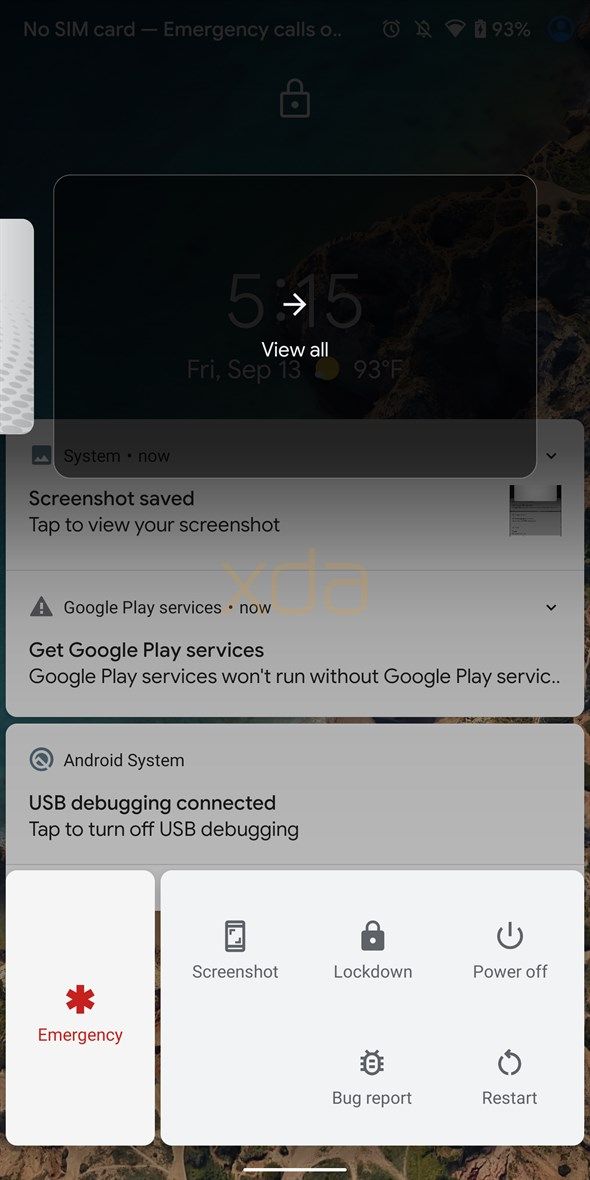
Quick Access Wallet first surfaced in the fourth Android Q beta version as “Show cards & passes“. It wasn’t working at the time and even while Google listed it as “Quick wallet access” among the Android 10 features after the stable release, the feature was still surprisingly absent. XDA’s Editor-in-Chief, Mishaal Rahman, later managed to activate the feature wherein he was able to add his cards or access the ones that were already saved in Google Pay by simply opening the power menu (i.e. long-pressing the power button).

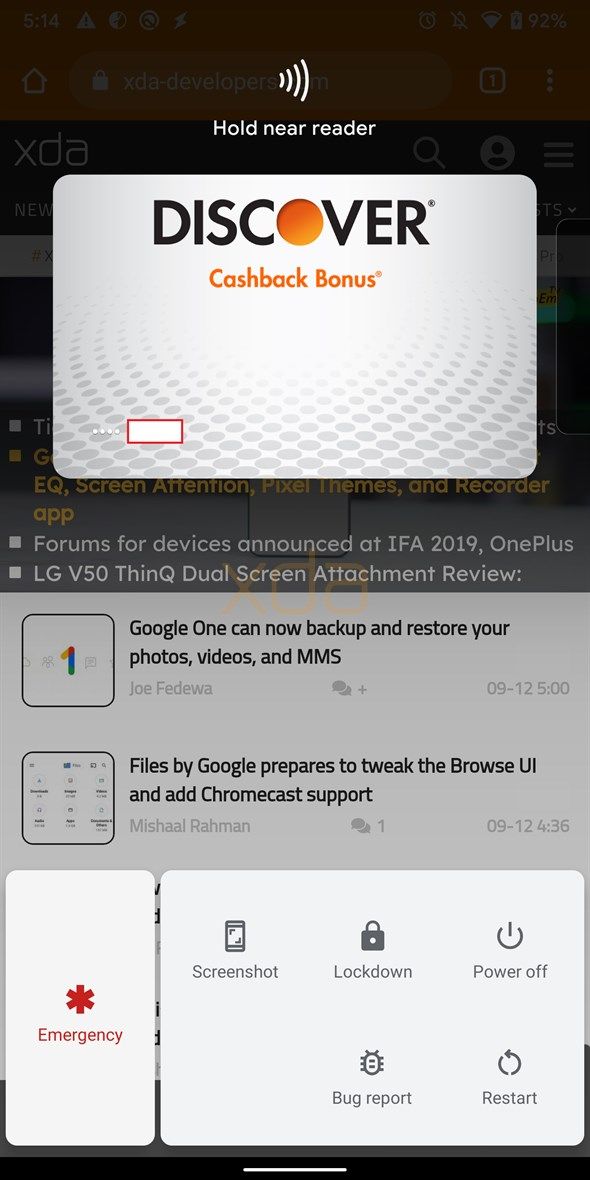
Android 10 Quick Wallet Access

Quick Access Wallet preview in Android 10

In Android 10, the Quick Access Wallet feature was evidently limited to the Google Pixel devices and only worked with payments using Google Pay. For several months, Google didn’t share any further detail about the feature. But with Android 11, Google is expectedly making a move to improve it by extending support beyond Google Pay. Any payment app will now be able to implement the QuickAccessWalletService API so that users can access cards, coupons, or tickets saved in that specific app directly from the power menu.

To implement the feature, the payment app will be required to add the required permission, i.e. android.permission.BIND_QUICK_ACCESS_WALLET_SERVICE, in its Manifest. This will allow the system to bind the service and not kill the app even when it is not used for long enough. To be able to use Quick Access Wallet with other apps in Android 11, users will be required to enable the feature from Settings > System > Gestures. Users will also have to select their default payment app in the Tap & Pay option in Settings.

If you have a Pixel device and want to try out the new Developer Preview, you can click on the links below and flash the system packages for your specific device. Do note that you’ll require an unlocked bootloader and you’ll have to back up your data before starting the process.

How to download Android 11 Developer Preview for Google Pixel and other devices

How to install the Android 11 Developer Preview on your Google Pixel smartphone

Android 11 News on XDA

The post Android 10’s hidden Quick Access Wallet for Google Pay is now a generic feature in Android 11 appeared first on xda-developers.


from xda-developers https://ift.tt/2P7yCR0
via IFTTT

The OmniVision OV64C is OmniVision’s first 64MP image sensor

As we have explained before, the smartphone camera megapixel wars have resumed in full swing. In 2019, most mainstream lower mid-range, upper mid-range and affordable flagship phones opted to use some form of a 48MP Quad Bayer sensor. In 2020, it seems 64MP will be the new standard resolution for smartphone cameras. Both Samsung and Sony have released their 64MP sensors in the form of the Samsung ISOCELL GW1 and the Sony IMX686 respectively. Samsung has even gone a step higher by releasing two 108MP sensors in the form of the ISOCELL HMX and the ISOCELL HM1, the latter of which is used in the Samsung Galaxy S20 Ultra. While the two companies battle it out for superiority, a third contender is quietly launching its own products in the market. The contender OmniVision, and so far, it hasn’t achieved success yet. It aims to keep trying, though, and it has now announced its own 64MP image sensor in the form of the OV64C.

In recent years, OmniVision’s image sensors have found use as secondary cameras on dual-camera, triple-camera, and quad-camera phones. However, in terms of the primary image sensor, we have to go all the way back to the Xiaomi Mi A1 and the OnePlus 2 to find smartphones using OmniVision’s image sensors as primary cameras. OmniVision launched the 48MP OV48C image sensor at CES with theoretically better specifications than the current 64MP sensors on the market, as it had a higher pixel size achieved by keeping the resolution constant. With the announcement of the OV64C, OmniVision has come back to competing on a level playing field as the sensor’s specifications are similar to that of its competitors. What this means is that it doesn’t offer any major fundamental advantages over something like the IMX686, unlike the OV48C. This is because a major constraint in cameras is pixel size, and the OV48C’s 1.2-micron pixel size and 2.4-micron “effective pixel size” is unparalleled for a high megapixel smartphone camera, while the 0.8-micron pixel size and 1.6-micron “effective pixel size” of the OV64C is on par with its competitors.

The OV48C is a 1/1.7-inch sensor, making it just as big as the ISOCELL GW1 and the IMX686. It has a corresponding 0.8-micron pixel size. It uses OmniVision’s PureCel Plus stacked die technology to provide “leading edge still image capture” and “exceptional 4K video performance” with electronic image stabilization (EIS) for high-end phones. The sensor also offers features such as 4-cell remosaic for full resolution Bayer output as well as digital crop zoom, and a CPHY interface for greater throughput using fewer pins. This makes it suitable for the main rear-facing camera in multi-camera configurations.

OmniVision notes that according to TSR (a market research company), there will be 127 million image sensors with 64MP or higher resolution shipped to smartphone manufacturers in 2020. This confirms the market reality where having a high megapixel sensor is seen as a must due to Huawei’s successful execution of the 40MP cameras in its flagship phones. This is the case even though flagship phones from the likes of Samsung, Google, and Apple still have 12MP primary cameras with excellent results. It’s promoting the OV64C as a well-positioned sensor to address “this ramp in demand among high-end smartphone designers.”

The OV64C integrates an on-chip 4-cell color filter array and hardware remosaic to provide high quality 64MP Bayer output in real time. (This makes it seem as if it’s a Quad Bayer sensor as all Quad Bayer sensors have a QCFA, but the meaning of the “64MP Bayer output” terminology is unclear.) In low light, the sensor can use “near-pixel binning” to output a 16MP image with 4x sensitivity as it offers a 1.6-micron equivalent performance for previews and still captures. In either case, OmniVision assures us that the sensor can consistently capture the best quality images. It also has 2x digital crop zoom with 16MP resolution and a fast mode switch.

Interestingly, the sensor features type-2, 2×2 microlens phase detection autofocus (microlens-PDAF) to boast autofocus accuracy, especially in low light. (This solution is similar to Sony’s 2×2 autofocus lens solution, which is confirmed to be a feature of the OPPO Find X2’s camera.) Output formats include 64MP at 15fps (indicating the lack of zero shutter lag), 16MP with 4-cell binning at 30fps, 4K video at 60fps, and 4K video with EIS at 30fps. (This makes it clear that 4K video at 60fps won’t support EIS, which is, unfortunately, a common omission across the Android smartphone industry.) In addition, the OV64C supports 3-exposure, staggered HDR timing for up to 16Mp video modes.

OmniVisoin says that the samples of the OV64C image sensor are available now. It remains to be seen whether major smartphone vendors will choose this sensor over the IMX686 and the ISOCELL GW1 in their 2020 smartphone launches.


Source: OmniVision

The post The OmniVision OV64C is OmniVision’s first 64MP image sensor appeared first on xda-developers.


from xda-developers https://ift.tt/3bLCtwO
via IFTTT

The OmniVision OV64C is OmniVision’s first 64MP image sensor

As we have explained before, the smartphone camera megapixel wars have resumed in full swing. In 2019, most mainstream lower mid-range, upper mid-range and affordable flagship phones opted to use some form of a 48MP Quad Bayer sensor. In 2020, it seems 64MP will be the new standard resolution for smartphone cameras. Both Samsung and Sony have released their 64MP sensors in the form of the Samsung ISOCELL GW1 and the Sony IMX686 respectively. Samsung has even gone a step higher by releasing two 108MP sensors in the form of the ISOCELL HMX and the ISOCELL HM1, the latter of which is used in the Samsung Galaxy S20 Ultra. While the two companies battle it out for superiority, a third contender is quietly launching its own products in the market. The contender OmniVision, and so far, it hasn’t achieved success yet. It aims to keep trying, though, and it has now announced its own 64MP image sensor in the form of the OV64C.

In recent years, OmniVision’s image sensors have found use as secondary cameras on dual-camera, triple-camera, and quad-camera phones. However, in terms of the primary image sensor, we have to go all the way back to the Xiaomi Mi A1 and the OnePlus 2 to find smartphones using OmniVision’s image sensors as primary cameras. OmniVision launched the 48MP OV48C image sensor at CES with theoretically better specifications than the current 64MP sensors on the market, as it had a higher pixel size achieved by keeping the resolution constant. With the announcement of the OV64C, OmniVision has come back to competing on a level playing field as the sensor’s specifications are similar to that of its competitors. What this means is that it doesn’t offer any major fundamental advantages over something like the IMX686, unlike the OV48C. This is because a major constraint in cameras is pixel size, and the OV48C’s 1.2-micron pixel size and 2.4-micron “effective pixel size” is unparalleled for a high megapixel smartphone camera, while the 0.8-micron pixel size and 1.6-micron “effective pixel size” of the OV64C is on par with its competitors.

The OV48C is a 1/1.7-inch sensor, making it just as big as the ISOCELL GW1 and the IMX686. It has a corresponding 0.8-micron pixel size. It uses OmniVision’s PureCel Plus stacked die technology to provide “leading edge still image capture” and “exceptional 4K video performance” with electronic image stabilization (EIS) for high-end phones. The sensor also offers features such as 4-cell remosaic for full resolution Bayer output as well as digital crop zoom, and a CPHY interface for greater throughput using fewer pins. This makes it suitable for the main rear-facing camera in multi-camera configurations.

OmniVision notes that according to TSR (a market research company), there will be 127 million image sensors with 64MP or higher resolution shipped to smartphone manufacturers in 2020. This confirms the market reality where having a high megapixel sensor is seen as a must due to Huawei’s successful execution of the 40MP cameras in its flagship phones. This is the case even though flagship phones from the likes of Samsung, Google, and Apple still have 12MP primary cameras with excellent results. It’s promoting the OV64C as a well-positioned sensor to address “this ramp in demand among high-end smartphone designers.”

The OV64C integrates an on-chip 4-cell color filter array and hardware remosaic to provide high quality 64MP Bayer output in real time. (This makes it seem as if it’s a Quad Bayer sensor as all Quad Bayer sensors have a QCFA, but the meaning of the “64MP Bayer output” terminology is unclear.) In low light, the sensor can use “near-pixel binning” to output a 16MP image with 4x sensitivity as it offers a 1.6-micron equivalent performance for previews and still captures. In either case, OmniVision assures us that the sensor can consistently capture the best quality images. It also has 2x digital crop zoom with 16MP resolution and a fast mode switch.

Interestingly, the sensor features type-2, 2×2 microlens phase detection autofocus (microlens-PDAF) to boast autofocus accuracy, especially in low light. (This solution is similar to Sony’s 2×2 autofocus lens solution, which is confirmed to be a feature of the OPPO Find X2’s camera.) Output formats include 64MP at 15fps (indicating the lack of zero shutter lag), 16MP with 4-cell binning at 30fps, 4K video at 60fps, and 4K video with EIS at 30fps. (This makes it clear that 4K video at 60fps won’t support EIS, which is, unfortunately, a common omission across the Android smartphone industry.) In addition, the OV64C supports 3-exposure, staggered HDR timing for up to 16Mp video modes.

OmniVisoin says that the samples of the OV64C image sensor are available now. It remains to be seen whether major smartphone vendors will choose this sensor over the IMX686 and the ISOCELL GW1 in their 2020 smartphone launches.


Source: OmniVision

The post The OmniVision OV64C is OmniVision’s first 64MP image sensor appeared first on xda-developers.


from xda-developers https://ift.tt/3bLCtwO
via IFTTT

Samsung begins mass production of 7nm and 6nm EUV chips at new EUV-equipped line

Samsung Foundry, a division of Samsung Electronics, has been going through tough times lately. At one time, it supplied chips for both Qualcomm and Apple, fabricating the Qualcomm Snapdragon 820/821, Snapdragon 835, Snapdragon 845, and partly supplying the Apple A9. However, over the last four years, Samsung has lost both Qualcomm and Apple as customers, as both companies have migrated to rival Taiwan Semiconductor Manufacturing Co. (TSMC). Apple fully migrated to TSMC with the A10 SoC, and kept using it for the A11, A12, and A13 SoCs. TSMC got the order to manufacture the 7nm Snapdragon 855. This year, it seemed as if Samsung could get back Qualcomm’s orders for the Snapdragon 865 with its cutting-edge 7nm EUV process. However, for reasons that are still unclear, Qualcomm opted to go with TSMC’s 7nm N7P (DUV) process for the Snapdragon 865, while using Samsung’s newer 7nm EUV process for the mid-range Snapdragon 765. It was indeed a piece of bad news, but Samsung hasn’t admitted defeat yet in its battle against market leader TSMC.

The company recently won a contract to supply some part of the 5nm chips for the Qualcomm Snapdragon X60 5G modem, which will make its way in flagship phones in 2021. Now, it has announced that it has begun mass production at its “cutting-edge” semiconductor fabrication EUV-equipped line in Hwaseong, South Korea. The facility is named V1, and it’s Samsung’s first semiconductor production line dedicated to the extreme ultraviolet (EUV) lithography process. It currently produces chips of 7nm and below (that is currently limited to 6nm). The line opened in February 2018, and began test wafer production in the second half of 2019. Its first products will be delivered to customers in the first quarter of this year.

Samsung says that the V1 line is currently producing mobile chips with 7nm and 6nm EUV process technology. It will continue to adopt finer circuitry up to the 3nm process node (which is currently in a design and testing phase). By the end of 2020, the cumulative total investment in the V1 line will reach $6 billion in accordance with the company’s plan. Also, the total capacity from 7nm and below process nodes is expected to triple from that of 2019. Along with the S3 line, the company expects the V1 line to play a “pivotal role” in responding to “fast-growing market demand for single-digit node foundry technologies.”

It has become a great achievement for the industry to reach ever-difficult new process nodes, and Samsung notes that as semiconductor geometries grow smaller, the adoption of EUV lithography technology has become increasingly important. That’s because it enables scaling down of complex patterns on wafers and provides an “optimal choice” for next-generation applications such as 5G, AI, and automotive. The company concludes by stating it now has a total of six foundry production lines in South Korea and the US, including five 12-inch lines and one 8-inch line.

The reason why Qualcomm opted to skip Samsung’s 7nm EUV process for the Snapdragon 865 to use a theoretically inferior 7nm N7P TSMC process and yet use Samsung for the Snapdragon 765 becomes clearer now. At this point, this remains only speculation, but it’s apparent that there were supply issues with Samsung’s 7nm EUV process. Even TSMC’s 7nm EUV N7+ node was used exclusively for the HiSilicon Kirin 990 5G in 2019. Samsung has only now begun mass production at the V1 line, which means that it was probably a quarter late to get a contract for the Snapdragon 865. It remains to be seen who will be manufacturing the upcoming Apple A14 and the Qualcomm Snapdragon 875 later this year. The company was curiously silent about progress on its 5nm process node in this announcement as well, so we will have to wait to know more about it.


Source: Samsung

The post Samsung begins mass production of 7nm and 6nm EUV chips at new EUV-equipped line appeared first on xda-developers.


from xda-developers https://ift.tt/3bSpYzH
via IFTTT

Samsung begins mass production of 7nm and 6nm EUV chips at new EUV-equipped line

Samsung Foundry, a division of Samsung Electronics, has been going through tough times lately. At one time, it supplied chips for both Qualcomm and Apple, fabricating the Qualcomm Snapdragon 820/821, Snapdragon 835, Snapdragon 845, and partly supplying the Apple A9. However, over the last four years, Samsung has lost both Qualcomm and Apple as customers, as both companies have migrated to rival Taiwan Semiconductor Manufacturing Co. (TSMC). Apple fully migrated to TSMC with the A10 SoC, and kept using it for the A11, A12, and A13 SoCs. TSMC got the order to manufacture the 7nm Snapdragon 855. This year, it seemed as if Samsung could get back Qualcomm’s orders for the Snapdragon 865 with its cutting-edge 7nm EUV process. However, for reasons that are still unclear, Qualcomm opted to go with TSMC’s 7nm N7P (DUV) process for the Snapdragon 865, while using Samsung’s newer 7nm EUV process for the mid-range Snapdragon 765. It was indeed a piece of bad news, but Samsung hasn’t admitted defeat yet in its battle against market leader TSMC.

The company recently won a contract to supply some part of the 5nm chips for the Qualcomm Snapdragon X60 5G modem, which will make its way in flagship phones in 2021. Now, it has announced that it has begun mass production at its “cutting-edge” semiconductor fabrication EUV-equipped line in Hwaseong, South Korea. The facility is named V1, and it’s Samsung’s first semiconductor production line dedicated to the extreme ultraviolet (EUV) lithography process. It currently produces chips of 7nm and below (that is currently limited to 6nm). The line opened in February 2018, and began test wafer production in the second half of 2019. Its first products will be delivered to customers in the first quarter of this year.

Samsung says that the V1 line is currently producing mobile chips with 7nm and 6nm EUV process technology. It will continue to adopt finer circuitry up to the 3nm process node (which is currently in a design and testing phase). By the end of 2020, the cumulative total investment in the V1 line will reach $6 billion in accordance with the company’s plan. Also, the total capacity from 7nm and below process nodes is expected to triple from that of 2019. Along with the S3 line, the company expects the V1 line to play a “pivotal role” in responding to “fast-growing market demand for single-digit node foundry technologies.”

It has become a great achievement for the industry to reach ever-difficult new process nodes, and Samsung notes that as semiconductor geometries grow smaller, the adoption of EUV lithography technology has become increasingly important. That’s because it enables scaling down of complex patterns on wafers and provides an “optimal choice” for next-generation applications such as 5G, AI, and automotive. The company concludes by stating it now has a total of six foundry production lines in South Korea and the US, including five 12-inch lines and one 8-inch line.

The reason why Qualcomm opted to skip Samsung’s 7nm EUV process for the Snapdragon 865 to use a theoretically inferior 7nm N7P TSMC process and yet use Samsung for the Snapdragon 765 becomes clearer now. At this point, this remains only speculation, but it’s apparent that there were supply issues with Samsung’s 7nm EUV process. Even TSMC’s 7nm EUV N7+ node was used exclusively for the HiSilicon Kirin 990 5G in 2019. Samsung has only now begun mass production at the V1 line, which means that it was probably a quarter late to get a contract for the Snapdragon 865. It remains to be seen who will be manufacturing the upcoming Apple A14 and the Qualcomm Snapdragon 875 later this year. The company was curiously silent about progress on its 5nm process node in this announcement as well, so we will have to wait to know more about it.


Source: Samsung

The post Samsung begins mass production of 7nm and 6nm EUV chips at new EUV-equipped line appeared first on xda-developers.


from xda-developers https://ift.tt/3bSpYzH
via IFTTT

mercredi 19 février 2020

Custom ROM throwback: Android 11 tests separating the Quick Settings panel from the notification shade

The first builds of Android 11 were released a few hours ago, coming to us in the form of Developer Preview 1. This new release of Android brings along a lot of new privacy and security-focused changes, several developer-oriented updates, and a whole bunch of changes that were not part of the announcement post from Google. While we were looking around for more new, unannounced changes in the newest version of Android, we stumbled upon something that surprised us…but not really. With Android 11, Google is testing a separation of the Quick Settings panel from the Notification Shade — a feature that used to exist in several older custom ROMs.

As Mishaal demonstrates on his Google Pixel 2 Xl running Android 11 Developer Preview 1, Android 11 is testing a feature that separates the Quick Settings dropdown from the Notification Panel dropdown, allowing you to quickly jump into either depending on which side of the status bar you pull down from. In the video, you can spot a white line on the status bar indicating the point of separation — swiping down from the left of this line will pull down the notification shade, while swiping down from the right of this line will pull down the Quick Settings panel. If your intent is to access the Quick Settings panel, this will streamline your experience by eliminating the double swipe that is currently needed to access them.

As is evident from the video, this feature is still very much a Work-in-Progress. The notifications do not align themselves properly to the top of the notification shade, and the Quick Settings panel has an odd line where the notifications would normally appear. This feature is thus not available for toggling by default and needs to be manually activated.

One theory with this UI test is that Google could be trying it out alongside other UI tests on the Quick Settings panel and Notification Shade, such as integrating music controls in the Quick Settings panel instead of the Notification panel. It could also be tied to the dedicated Conversation view in the Notification Shade, and coupled with the aforementioned music controls change, can be seen as an attempt to declutter the Notification Shade and improve the overall experience.

If you have been around the custom ROM scenes in the era of Gingerbread and Ice Cream Sandwich, you would realize that this isn’t exactly a new feature. I personally recall having used this feature on Touchwiz-based custom ROMs based on Android 2.3.4 Gingerbread as well as on heavily modified CyanogenMod builds that were based on Android 4.0 Ice Cream Sandwich. It appears that Google has now taken inspiration from custom ROMs for this UI test, though at this stage, there’s no guarantee that this feature will make its way to the final release of Android 11.

Android 11 News on XDA

The post Custom ROM throwback: Android 11 tests separating the Quick Settings panel from the notification shade appeared first on xda-developers.


from xda-developers https://ift.tt/2SHVx7P
via IFTTT

Wild Android 11 test puts a music player in the Quick Settings panel

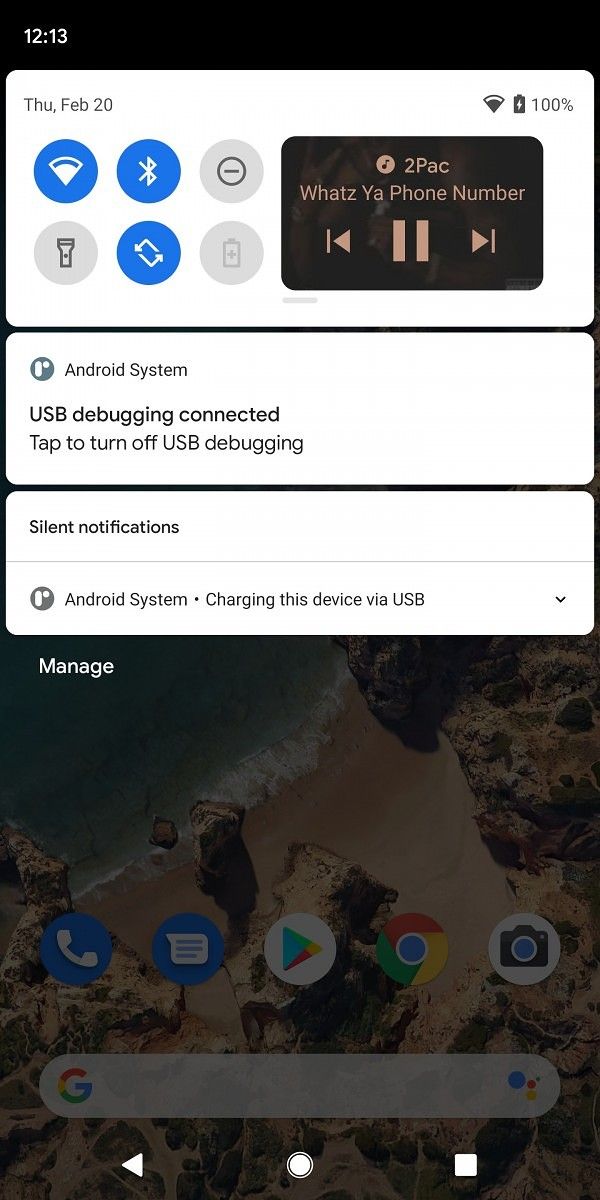
The first Android 11 developer preview is out and we’ve already covered some of the changes we found from Android 10 so far. The latest iteration of Android also comes with some new privacy and security features, along with a few new features for developers. But that’s not all. Google is scheduled to roll out two more developer previews and three betas before the final stable release and while the company won’t be announcing any of the new features till Google I/O 2020, we’ll continue to tinker with the latest build to find upcoming features in Android 11. We’ve already uncovered several such features, including a new increased touch sensitivity option for the Pixel 4, a Motion Sense gesture for controlling music playback on the device, new screenshot previews, and even a fully redesigned Notification History page. And now, our Editor-in-Chief Mishaal Rahman has managed to manually enable a new feature that puts a music player in the Quick Settings in the notification shade.

In current builds of Android, whenever you’re listening to music on your phone a music player appears in the notifications shade. Sometimes, when you receive too many notifications, the music player is moved to the bottom and you have to open the notification shade all the way in order to access it. This could prove to be a bit of an annoyance, especially if you’re someone who receives a ton of notifications.

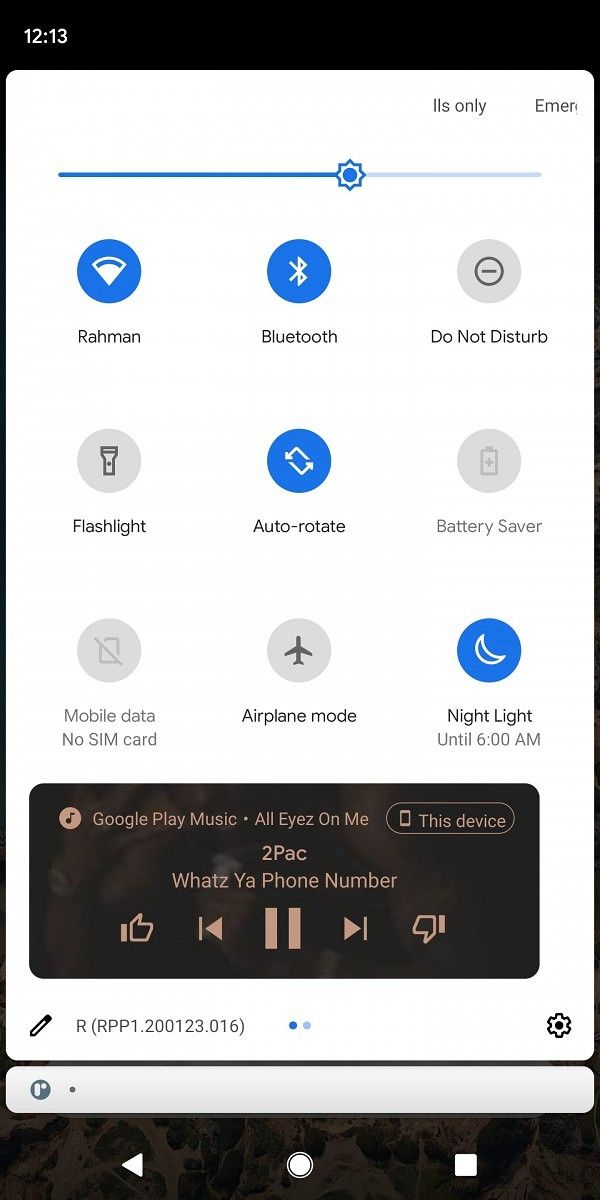
It seems like Google is aware of this issue and might be addressing it in a future build of Android 11 by putting the music player in the Quick Settings panel. As you can see in the screenshots above, the music player will appear as a part of the Quick Settings panel right next to the other toggles. In order to accommodate the music player, the Quick Settings panel will expand from one to two rows and will display the Quick Settings toggles on one side, while the music player will take up the other side.

Opening the Quick Settings panel completely by swiping down once again will move the music player to the bottom of the panel, with all the toggles right above it. In a bid to accommodate the music player, the Quick Settings panel will take up more space than it does currently but, on the positive side, the music player will always be accessible right at the top. As of now, this feature is not accessible by default on the first Android 11 developer preview and we had to manually enable it in order to take these screenshots. It’s also worth mentioning that this is one of several UI tests in Android 11, so it may or may not appear in the stable build. In case it does, there’s also a chance that Google might make some significant changes to it before launch.

The post Wild Android 11 test puts a music player in the Quick Settings panel appeared first on xda-developers.


from xda-developers https://ift.tt/3bPdY1L
via IFTTT