LightBlog

mercredi 19 février 2020

[Update: Launched in India] Samsung Galaxy A71 launches with punch hole display and 64MP quad rear camera

Update 1 (02/19/2020 @ 04:00 AM ET): Samsung has launched the Galaxy A71 in India. Scroll to the bottom for more information. The article as published on December 12, 2019, is preserved as below.

It was only a couple of weeks ago when we got our first glimpse of the Samsung Galaxy A71 in leaked renders. Today, the company officially, but quietly, unveiled the device alongside the Galaxy A51. This is one of the most attractive devices we’ve seen so far in Samsung’s popular A-series. The Galaxy A71 offers some premium features for what we assume will be a reasonable price. Let’s take a look.

Specifications Samsung Galaxy A71
Display 6.7-inch, Full HD+ (1080 x2400)
Super AMOLED
Infinity-O Display
Camera
  • Main: 64MP, F1.8
  • Depth: 5MP, F2.2
  • Macro: 5MP, F2.4
  • Ultra-wide : 12MP, F2.2
Front Selfie: 32MP, F2.2
Body 163.6 x 76.0 x 7.7mm
179g
Processor Octa-Core (Dual 2.2GHz + Hexa 1.8GHz)
Memory 6/8 GB RAM
128GB Internal Storage
Micro SD slot (up to 512 GB)
SIM Card Dual SIM (3 slot)
Battery 4,500 mAh
25W Super-Fast Charging
Security On-Screen Fingerprint
Face Recognition
Color Prism Crush Black / Silver/ Blue / Pink

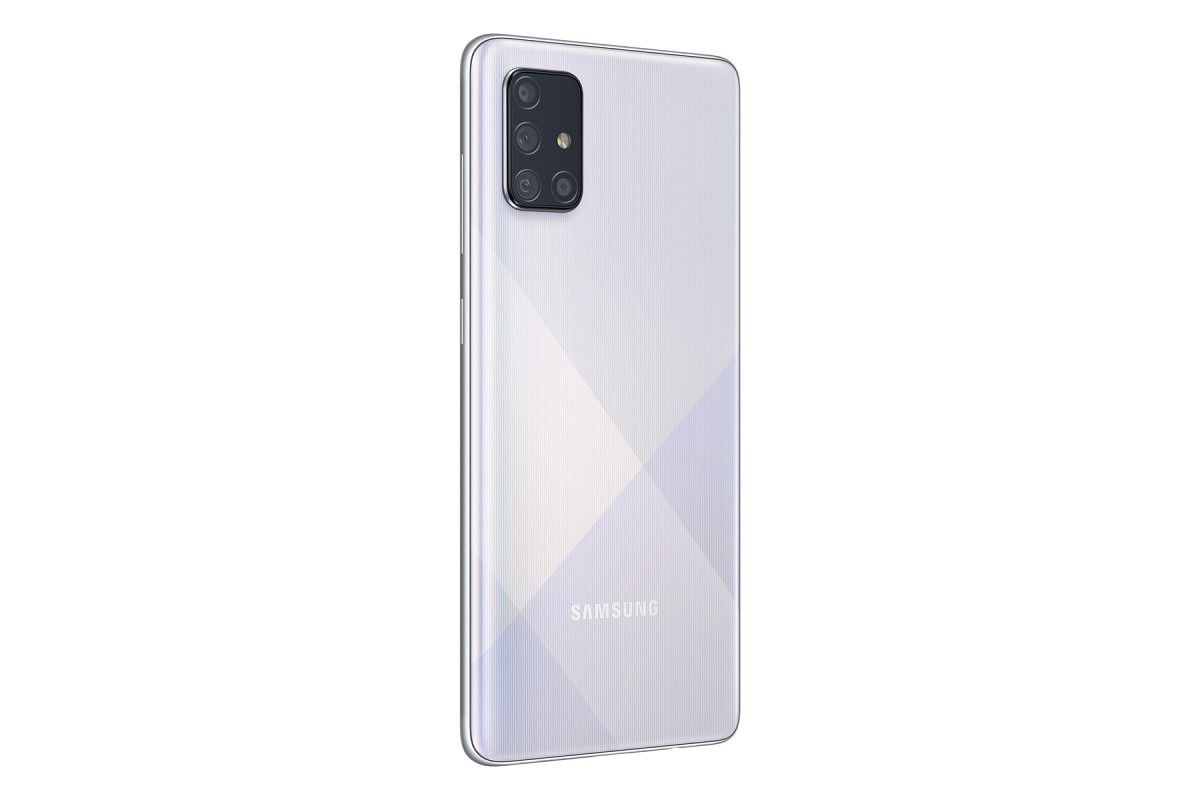
The Galaxy A71 falls in line with the new design that Samsung has been showcasing with the A-series. It has a single, centered hole-punch on the front and quad cameras on the rear in a big rectangular bunch. The back of the device also features a gradient cross-hatch pattern in four different color options: Black, Silver, Blue, and Pink.

The quad cameras start with the 64MP main shooter with f/1.8 aperture. Next up is the 12MP ultra-wide camera at f/2.2. We round things out with dual 5MP cameras, one being a depth sensor and the other a macro lens. Combined with the 32MP front camera, there are plenty of megapixels to go around.

Samsung Galaxy A71 Samsung Galaxy A71 Samsung Galaxy A71 Samsung Galaxy A71

Moving to the front, the Galaxy A71 has a 6.7-inch Full HD+ Super AMOLED display with the aforementioned “Infinity-O” punch-hole. The bezels around the display are very thin and nearly the same on all sides (the bottom chin is slightly thicker). There is also an in-display fingerprint sensor present here.

Let’s talk about power. The Galaxy A71 is equipped with an unnamed octa-core dual 2.2GHz + 1.8GHz processor, 6/8 GB of RAM, and 128 GB of storage. The processor is likely the Qualcomm Snapdragon 730. Battery life should be good as it’s packing a 4,500 mAh battery. Lastly, the A71 should ship with One UI 2.0 on top of Android 10.

Unfortunately, Samsung did not share when the Galaxy A71 will be available for purchase or how much it will cost. The Galaxy A70 was a very affordable device and we expect the A71 to be similar.

Source: Samsung | Via: SamMobile


Update: Samsung Galaxy A71 launched in India for ₹29,999 ($420)

Samsung has launched the Galaxy A71 in India for a price of ₹29,999 ($420) for the 8GB/128GB variant. Interested customers can pick up the phone in Prism Crush Silver, Blue, and Black colors, starting from February 24, 2020 across online and offline stores in the country.

Samsung Galaxy A71 — Hands-On

The post [Update: Launched in India] Samsung Galaxy A71 launches with punch hole display and 64MP quad rear camera appeared first on xda-developers.


from xda-developers https://ift.tt/2E8Cbk2
via IFTTT

[Update: Launched in India] Samsung Galaxy A71 launches with punch hole display and 64MP quad rear camera

Update 1 (02/19/2020 @ 04:00 AM ET): Samsung has launched the Galaxy A71 in India. Scroll to the bottom for more information. The article as published on December 12, 2019, is preserved as below.

It was only a couple of weeks ago when we got our first glimpse of the Samsung Galaxy A71 in leaked renders. Today, the company officially, but quietly, unveiled the device alongside the Galaxy A51. This is one of the most attractive devices we’ve seen so far in Samsung’s popular A-series. The Galaxy A71 offers some premium features for what we assume will be a reasonable price. Let’s take a look.

Specifications Samsung Galaxy A71
Display 6.7-inch, Full HD+ (1080 x2400)
Super AMOLED
Infinity-O Display
Camera
  • Main: 64MP, F1.8
  • Depth: 5MP, F2.2
  • Macro: 5MP, F2.4
  • Ultra-wide : 12MP, F2.2
Front Selfie: 32MP, F2.2
Body 163.6 x 76.0 x 7.7mm
179g
Processor Octa-Core (Dual 2.2GHz + Hexa 1.8GHz)
Memory 6/8 GB RAM
128GB Internal Storage
Micro SD slot (up to 512 GB)
SIM Card Dual SIM (3 slot)
Battery 4,500 mAh
25W Super-Fast Charging
Security On-Screen Fingerprint
Face Recognition
Color Prism Crush Black / Silver/ Blue / Pink

The Galaxy A71 falls in line with the new design that Samsung has been showcasing with the A-series. It has a single, centered hole-punch on the front and quad cameras on the rear in a big rectangular bunch. The back of the device also features a gradient cross-hatch pattern in four different color options: Black, Silver, Blue, and Pink.

The quad cameras start with the 64MP main shooter with f/1.8 aperture. Next up is the 12MP ultra-wide camera at f/2.2. We round things out with dual 5MP cameras, one being a depth sensor and the other a macro lens. Combined with the 32MP front camera, there are plenty of megapixels to go around.

Samsung Galaxy A71 Samsung Galaxy A71 Samsung Galaxy A71 Samsung Galaxy A71

Moving to the front, the Galaxy A71 has a 6.7-inch Full HD+ Super AMOLED display with the aforementioned “Infinity-O” punch-hole. The bezels around the display are very thin and nearly the same on all sides (the bottom chin is slightly thicker). There is also an in-display fingerprint sensor present here.

Let’s talk about power. The Galaxy A71 is equipped with an unnamed octa-core dual 2.2GHz + 1.8GHz processor, 6/8 GB of RAM, and 128 GB of storage. The processor is likely the Qualcomm Snapdragon 730. Battery life should be good as it’s packing a 4,500 mAh battery. Lastly, the A71 should ship with One UI 2.0 on top of Android 10.

Unfortunately, Samsung did not share when the Galaxy A71 will be available for purchase or how much it will cost. The Galaxy A70 was a very affordable device and we expect the A71 to be similar.

Source: Samsung | Via: SamMobile


Update: Samsung Galaxy A71 launched in India for ₹29,999 ($420)

Samsung has launched the Galaxy A71 in India for a price of ₹29,999 ($420) for the 8GB/128GB variant. Interested customers can pick up the phone in Prism Crush Silver, Blue, and Black colors, starting from February 24, 2020 across online and offline stores in the country.

Samsung Galaxy A71 — Hands-On

The post [Update: Launched in India] Samsung Galaxy A71 launches with punch hole display and 64MP quad rear camera appeared first on xda-developers.


from xda-developers https://ift.tt/2E8Cbk2
via IFTTT

mardi 18 février 2020

Future Galaxy S20 update may enable 120Hz refresh rate at QHD+ resolution

High refresh rate displays are all rage nowadays. The feature that was once limited to gaming-oriented phones has been steadily trickling down to more mainstream devices lately. From the top-of-the-line flagship to the affordable mid-range, it’s quickly becoming commonplace. One of the latest phones to launch with a high refresh display is Samsung’s Galaxy S20 lineup which features a 120Hz panel across the range. But one drawback with a higher refresh rate is the increase in battery draw. In the case of the Galaxy S20 series, it also packs a QHD‌+ resolution display which combined with the high display refresh rate could potentially result in even higher battery consumption. To avoid excessive power consumption, Samsung chose to restrict the 120Hz high refresh rate to 1080p resolution only, and make it unavailable at QHD+.

XDA Forums: Samsung Galaxy S20 || Samsung Galaxy S20+ || Samsung Galaxy S20 Ultra

This could be a bummer for those wanting to experience the smoothness of 120Hz refresh rate in crisp QHD+ resolution. But it appears Samsung may address this concern in a future update. According to our own Max Weinbach, Samsung is currently in the process of optimizing software to enable a 120Hz refresh rate at QHD+ resolution and could release it to the Galaxy S20 series in the coming months if everything goes as intended.

Separately, Ice Universe has shared a screenshot of an in-development firmware build which suggests Samsung could allow users to select the 120Hz refresh rate at the maximum screen resolution. Samsung may be allowing this in response to strong user feedback. They may or may not have solved the underlying power consumption issues, though. Given how large the batteries are on the S20 series, though, we doubt users will have many problems.

Power consumption wouldn’t have been a concern if Samsung had used LTPO (low-temperature polycrystalline oxide) display technology which dynamically controls the refresh rate based on the user interaction. However, as per Ross Young from DSCC, the technology is still in its infancy and won’t be available for smartphones until later this year. The only devices on the market that uses LTPO are the Apple Watch Series 5 and Samsung’s Galaxy Watch Active 2.


Source: @UniverseIce; @MaxWinebach

The post Future Galaxy S20 update may enable 120Hz refresh rate at QHD+ resolution appeared first on xda-developers.


from xda-developers https://ift.tt/2HxV95k
via IFTTT

Future Galaxy S20 update may enable 120Hz refresh rate at QHD+ resolution

High refresh rate displays are all rage nowadays. The feature that was once limited to gaming-oriented phones has been steadily trickling down to more mainstream devices lately. From the top-of-the-line flagship to the affordable mid-range, it’s quickly becoming commonplace. One of the latest phones to launch with a high refresh display is Samsung’s Galaxy S20 lineup which features a 120Hz panel across the range. But one drawback with a higher refresh rate is the increase in battery draw. In the case of the Galaxy S20 series, it also packs a QHD‌+ resolution display which combined with the high display refresh rate could potentially result in even higher battery consumption. To avoid excessive power consumption, Samsung chose to restrict the 120Hz high refresh rate to 1080p resolution only, and make it unavailable at QHD+.

XDA Forums: Samsung Galaxy S20 || Samsung Galaxy S20+ || Samsung Galaxy S20 Ultra

This could be a bummer for those wanting to experience the smoothness of 120Hz refresh rate in crisp QHD+ resolution. But it appears Samsung may address this concern in a future update. According to our own Max Weinbach, Samsung is currently in the process of optimizing software to enable a 120Hz refresh rate at QHD+ resolution and could release it to the Galaxy S20 series in the coming months if everything goes as intended.

Separately, Ice Universe has shared a screenshot of an in-development firmware build which suggests Samsung could allow users to select the 120Hz refresh rate at the maximum screen resolution. Samsung may be allowing this in response to strong user feedback. They may or may not have solved the underlying power consumption issues, though. Given how large the batteries are on the S20 series, though, we doubt users will have many problems.

Power consumption wouldn’t have been a concern if Samsung had used LTPO (low-temperature polycrystalline oxide) display technology which dynamically controls the refresh rate based on the user interaction. However, as per Ross Young from DSCC, the technology is still in its infancy and won’t be available for smartphones until later this year. The only devices on the market that uses LTPO are the Apple Watch Series 5 and Samsung’s Galaxy Watch Active 2.


Source: @UniverseIce; @MaxWinebach

The post Future Galaxy S20 update may enable 120Hz refresh rate at QHD+ resolution appeared first on xda-developers.


from xda-developers https://ift.tt/2HxV95k
via IFTTT

Xiaomi releases the Redmi K30 5G kernel source code

Late last year in December, Xiaomi launched the Redmi K30 and Redmi K30 5G in China. While the company hasn’t launched the devices internationally yet, its former sub-brand POCO launched the Redmi K30 as the POCO X2 earlier this month in India. In a bid to promote third-party development for the device, POCO also released its kernel source code at the launch event. POCO’s dev-friendly nature and its willingness to support the modding community is one of the main reasons behind the brand’s popularity. Now, it seems like Xiaomi is following in its footsteps and has released the kernel sources for the Redmi K30 5G, even before its launch in international markets.

Redmi K30 5G XDA Forums

The timely kernel source code release is expected to jumpstart development efforts for the mid-range 5G device from the company. Not only will it help power users improve the device’s performance by analyzing the code, but it will also help developers release custom ROMs and kernels for the device. If you’re planning on purchasing the device and are interested in pushing the device to its limits, you should head over to our Redmi K30 5G forums from the link above and keep a tab on the third-party development for the device. We expect to see some great custom ROMs and kernel releases for the device following the launch, which will help you make the most out of your new phone. If you’re a developer, on the other hand, you can access the kernel sources on GitHub from the link below and spearhead development for the device.

Redmi K30 5G Kernel Sources

The post Xiaomi releases the Redmi K30 5G kernel source code appeared first on xda-developers.


from xda-developers https://ift.tt/2SFXdP4
via IFTTT

Xiaomi releases the Redmi K30 5G kernel source code

Late last year in December, Xiaomi launched the Redmi K30 and Redmi K30 5G in China. While the company hasn’t launched the devices internationally yet, its former sub-brand POCO launched the Redmi K30 as the POCO X2 earlier this month in India. In a bid to promote third-party development for the device, POCO also released its kernel source code at the launch event. POCO’s dev-friendly nature and its willingness to support the modding community is one of the main reasons behind the brand’s popularity. Now, it seems like Xiaomi is following in its footsteps and has released the kernel sources for the Redmi K30 5G, even before its launch in international markets.

Redmi K30 5G XDA Forums

The timely kernel source code release is expected to jumpstart development efforts for the mid-range 5G device from the company. Not only will it help power users improve the device’s performance by analyzing the code, but it will also help developers release custom ROMs and kernels for the device. If you’re planning on purchasing the device and are interested in pushing the device to its limits, you should head over to our Redmi K30 5G forums from the link above and keep a tab on the third-party development for the device. We expect to see some great custom ROMs and kernel releases for the device following the launch, which will help you make the most out of your new phone. If you’re a developer, on the other hand, you can access the kernel sources on GitHub from the link below and spearhead development for the device.

Redmi K30 5G Kernel Sources

The post Xiaomi releases the Redmi K30 5G kernel source code appeared first on xda-developers.


from xda-developers https://ift.tt/2SFXdP4
via IFTTT

Microsoft Your Phone brings RCS and cross-device copy and paste to Windows if you have the Galaxy S20 or Z Flip

 Microsoft has seemingly held a growing love for the Android platform in recent months, instigating a relationship with Samsung and integrating the company’s Your Phone app into Samsung smartphones. The premise is simple – link your Samsung smartphone to your computer and share notifications, make phone calls, and more between your phone and computer. The app was first launched alongside the Samsung Galaxy Note 10 but later made its way to other devices too. Now there are more exclusive Samsung features for the Galaxy S20 series and the Galaxy Z Flip – cross-device copy and paste, and RCS via Windows.

In the case of cross-device copy and paste as part of the Your Phone app, there’s no word as to whether or not that will always remain a Samsung exclusive, though it’s very likely to be. The support page for cross-device copy-paste is already live and it is available for Samsung Galaxy S20, Samsung Galaxy S20+, Samsung Galaxy S20 Ultra, and Samsung Galaxy Z Flip devices only. It’s likely to remain a Samsung exclusive for some time, as the clipboard can only be read in Android 10 if the app is the active foreground application.
The Your Phone app integrates with the Galaxy S20 series and Z Flip

As for RCS, that technology has had somewhat of a rocky history, though carriers are finally beginning to implement it. Through the Your Phone app on the Galaxy S20 series of smartphones, you’ll be able to send RCS messages from your PC through your phone, with no word on there being an exclusivity time period or not. The feature was announced by Roberto Bojorquez on Twitter, a group program manager at Microsoft. You’ll need to use the default Samsung Messages app though, and there’s no word on whether or not this will also be available for the Samsung Galaxy Z Flip. You can download the Your Phone app below.

Your Phone Companion - Link to Windows (Free, Google Play) →


Via: Android Police | Via 2: Android Police

The post Microsoft Your Phone brings RCS and cross-device copy and paste to Windows if you have the Galaxy S20 or Z Flip appeared first on xda-developers.


from xda-developers https://ift.tt/3bIHAhr
via IFTTT