LightBlog

mardi 18 février 2020

Qualcomm announces the Snapdragon X60 modem for flagship 5G smartphones

Qualcomm has announced the Snapdragon X60 modem for flagship 5G phones. The news comes almost exactly a year after the announcement of its predecessor, the Snapdragon X55 modem. The Snapdragon X60 is the third-generation 5G modem-RF system from Qualcomm, succeeding the Snapdragon X55, which in turn succeeded the first-generation Snapdragon X50. The company has also announced the new ultraSAW RF filter technology. Let’s take a look at both of these announcements one-by-one:

Snapdragon X60 modem-RF system
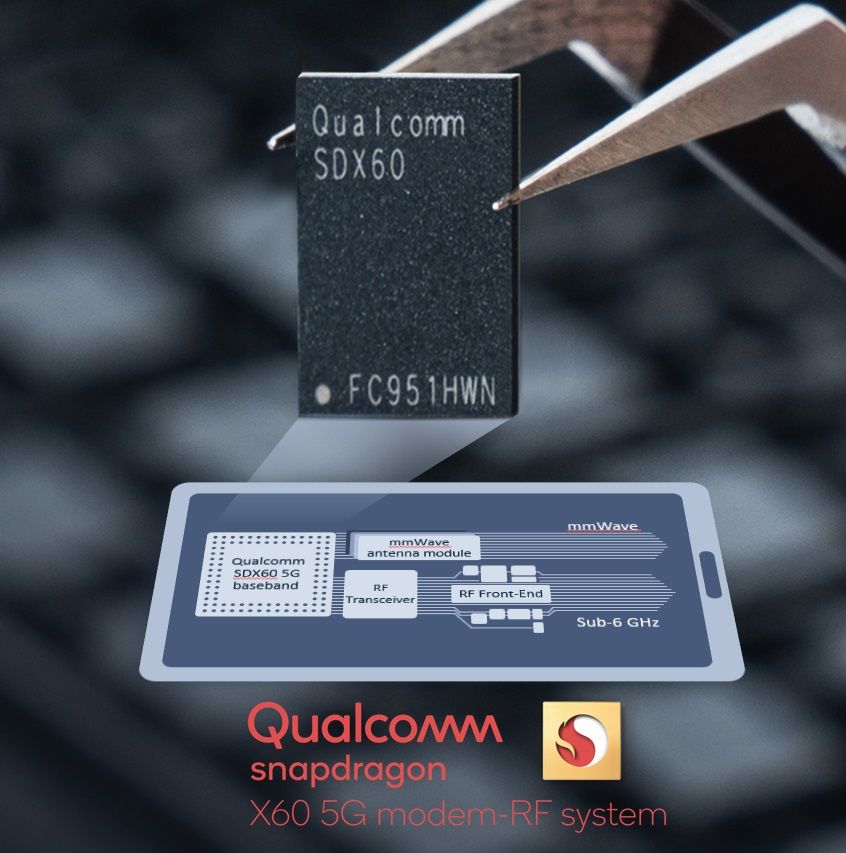
The Snapdragon X60 features the world’s first 5nm baseband. (Qualcomm didn’t state who will be manufacturing the X60, but given TSMC’s leadership in the 5nm process, it’s likely to be manufactured on TSMC’s 5nm FinFET process.) The 5nm process will lead to power efficiency gains in a smaller footprint.

The Snapdragon X60 is also the world’s first 5G modem-RF system to support spectrum aggregation across all key 5G bands and combinations, including millimeter wave (mmWave) and sub-6 (sub-6GHz 5G) using frequency division duplex (FDD) and time division duplex (TDD).

The system is engineered to accelerate network transition to 5G stand-alone mode through support for any key spectrum band, mode or combination. All 5G networks until now are using non-stand alone (NSA) mode, which means they require an LTE anchor for a 5G data link. 5G networks will soon transition to SA mode, however, which will allow them to be able to operate independently of LTE as the connection will be exclusively a 5G data link. The transition from NSA to SA will start in 2020 and continue in 2021.

The Snapdragon X60 features support for 5G Voice over NR (VoNR), which is the successor to VoLTE. It will allow users to make calls over 5G networks.

It also features the new Qualcomm QTM535 mmWave antenna module, which is the company’s third-generation 5G mmWave antenna module, succeeding the QTM525 and QTM052 modules. This module has support for the 26/28/39GHz bands that are being/will be used in mmWave 5G networks in North America, South Korea, Japan, and Europe. As a quick reminder, 5G smartphones incorporating mmWave need at least two of these antenna modules, in addition to the modem itself. This is because mmWave requires a line-of-sight to the node to maintain connection, and its signal is so poor that it can be blocked by buildings, trees, and even a user’s hand. It also doesn’t work indoors. Therefore, device makers place these modules in different orientations (one will be placed on the top while the second will be placed on the left/right hand sides) of the phone so that it’s not blocked by the user’s hand. The QTM535 features a more compact design than the previous generation (Qualcomm didn’t give specifics here), which will presumably lead to thinner phones.

The Snapdragon X60 allows for fiber-like Internet speeds and low latency, delivered wirelessly over 5G. Qualcomm hopes it will unlock the next generation of connected applications and experiences such as highly responsive multiplayer gaming, immersive 360-degree video and connected cloud computing. It will have “superior” power efficiency for “all-day battery life.”

Qualcomm Snapdragon X60 modemThe major new feature of the Snapdragon X60 is that it’s the world’s first to support mmWave-sub-6 aggregation, which should allow carriers to maximise their spectrum resources to combine capacity and coverage. With this aggregation, carriers can have their peak throughput surpass 5.5Gbps, according to Qualcomm. It’s also a way to have the best of both worlds as carriers can have both network coverage as well as capacity. Serious doubts remain on mmWave’s ability to function as an effective 5G mechanism, though, because of the aforementioned limitations of the technology. The optimal use case for mmWave will probably be for outdoor public places such as landmarks, while sub-6 5G will function as the effective successor of 4G LTE.

It also features the world’s first 5G FDD-TDD sub-6 carrier aggregation solution for double the speeds. This comes in addition to supporting 5G FDD-FDD and TDD-TDD carrier aggregation, along with dynamic spectrum sharing (DSS), which was introduced last year with the Snapdragon X55. DSS allows operators to deploy 5G services on low frequency FDD bands already in use for LTE, which is what T-Mobile is doing with its low-band “nationwide” 600MHz 5G network. The Snapdragon X60 gives carriers a wide range of deployment options such as being able to repurpose LTE spectrum for 5G to deliver higher average network speeds and accelerate 5G expansion.

Qualcomm says that with smartphones based on Snapdragon X60, operators can utilize a mix of frequency bands (mmWave, sub-6 GHz – including low bands), band types (5G FDD and TDD), and deployment modes (SA and NSA) to achieve an optimal combination of high-speed and low-latency network coverage.

The Snapdragon X60’s theoretical maximum downlink goes up to 7.5Gbps, while the maximum uplink stays at 3Gbps. In comparison, the Snapdragon X55’s theoretical maximum downlink is 7Gbps. Qualcomm says that the aggregation of sub-6GHz spectrum in SA mode allows the doubling of peak data rates in SA mode compared to solutions with no carrier aggregation support (i.e. the Snapdragon X55). Also, VoNR support will allow mobile operators to provide high-quality voice services on 5G NR.

In conclusion, Qualcomm says the Snapdragon X60 is the extension of a modem-to-antenna family that combines the baseband, transceiver, and complete RF-front-end for mmWave and sub-6GHz. The company is scheduled to ship samples of the Snapdragon X60 and QTM535 in the first quarter of 2020, with commercial premium phones using the new modem-RF system expected in early 2021. This means the modem-RF system will likely be paired with the next-generation Snapdragon flagship SoC, the Snapdragon 875. What we don’t know yet is whether the Snapdragon 875 will integrate this 5G modem on-chip like the Snapdragon 765, or whether it will remain a discrete modem like the Snapdragon 865. This piece of information will be revealed in December at the annual Tech Summit. Another piece of unknown information is whether the Snapdragon 865 supports the X60 modem.

The 5nm process also means the Snapdragon X60 is unlikely to ship on products this year. In 2019, the 7nm Snapdragon X55 did manage to ship on two Snapdragon 855-powered products: the 5G AT&T and T-Mobile variants of the Samsung Galaxy Note 10+ as well as the T-Mobile OnePlus 7T Pro 5G McLaren.

ultraSAW RF filter technology

Along with the Snapdragon X60, Qualcomm has also announced its ultraSAW RF filter technology. This is said to be another “groundbreaking innovation”. It’s said to significantly improve radio frequency performance in bands up to 2.7GHz, and it’s also said to outperform competing filter technologies at lower cost.

Radio frequency (RF) signals isolate radio signals from the different spectrum bands that phones use to receive and transmit information. According to Qualcomm, its ultraSAW filters achieve as much as 1 decibel (db) improvement in insertion loss, thereby offering a higher performance solution compared to competing bulk-acoustic (BAW) filters in the sub-2.7GHz frequency range.

Qualcomm’s ultraSAW technology is said to achieve superior filter characteristics to deliver high performance in frequencies from 600MHz to 2.7GHz with benefits including excellent transmit, receive and cross isolation; high frequency selectivity; a Q-factor of up to 5,000 – which Qualcomm says is significantly higher than the quality factor of competing BAW filters; very low insertion low; and excellent temperature stability with very low temperature drift in the single-digit ppm/Kelvin range. According to the company, all of this allows for more-efficient RF paths in 5G and 4G multi-mode devices at a lower cost point than competing commercial solutions with similar performance metrics for OEMs.

The ultraSAW technology serves as a key one behind the performance of Qualcomm’s radio frequency front-end (RFFE) product portfolio (which is under scrutiny by the European Commission) as well as its 5G modem-RF systems. The company is integrating this technology across its product line including PA modules, front-end modules, diversity modules, Wi-Fi extractors, GNSS extractors, and RF multipliers.

For consumers, Qualcomm says that improved RF performance will help device makers bring 5G devices with superior connectivity and battery life to consumers. A lineup of discrete and integrated Qualcomm ultraSAW products will begin production this quarter. Flagship devices from device makers are expected to be commercially available in the second half of 2020.

The post Qualcomm announces the Snapdragon X60 modem for flagship 5G smartphones appeared first on xda-developers.


from xda-developers https://ift.tt/2SYgp9C
via IFTTT

Qualcomm announces the Snapdragon X60 modem for flagship 5G smartphones

Qualcomm has announced the Snapdragon X60 modem for flagship 5G phones. The news comes almost exactly a year after the announcement of its predecessor, the Snapdragon X55 modem. The Snapdragon X60 is the third-generation 5G modem-RF system from Qualcomm, succeeding the Snapdragon X55, which in turn succeeded the first-generation Snapdragon X50. The company has also announced the new ultraSAW RF filter technology. Let’s take a look at both of these announcements one-by-one:

Snapdragon X60 modem-RF system

The Snapdragon X60 features the world’s first 5nm baseband. (Qualcomm didn’t state who will be manufacturing the X60, but given TSMC’s leadership in the 5nm process, it’s likely to be manufactured on TSMC’s 5nm FinFET process.) The 5nm process will lead to power efficiency gains in a smaller footprint.

The Snapdragon X60 is also the world’s first 5G modem-RF system to support spectrum aggregation across all key 5G bands and combinations, including millimeter wave (mmWave) and sub-6 (sub-6GHz 5G) using frequency division duplex (FDD) and time division duplex (TDD).

The system is engineered to accelerate network transition to 5G stand-alone mode through support for any key spectrum band, mode or combination. All 5G networks until now are using non-stand alone (NSA) mode, which means they require an LTE anchor for a 5G data link. 5G networks will soon transition to SA mode, however, which will allow them to be able to operate independently of LTE as the connection will be exclusively a 5G data link. The transition from NSA to SA will start in 2020 and continue in 2021.

The Snapdragon X60 features support for 5G Voice over NR (VoNR), which is the successor to VoLTE. It will allow users to make calls over 5G networks.

It also features the new Qualcomm QTM535 mmWave antenna module, which is the company’s third-generation 5G mmWave antenna module, succeeding the QTM525 and QTM052 modules. This module has support for the 26/28/39GHz bands that are being/will be used in mmWave 5G networks in North America, South Korea, Japan, and Europe. As a quick reminder, 5G smartphones incorporating mmWave need at least two of these antenna modules, in addition to the modem itself. This is because mmWave requires a line-of-sight to the node to maintain connection, and its signal is so poor that it can be blocked by buildings, trees, and even a user’s hand. It also doesn’t work indoors. Therefore, device makers place these modules in different orientations (one will be placed on the top while the second will be placed on the left/right hand sides) of the phone so that it’s not blocked by the user’s hand. The QTM535 features a more compact design than the previous generation (Qualcomm didn’t give specifics here), which will presumably lead to thinner phones.

The Snapdragon X60 allows for fiber-like Internet speeds and low latency, delivered wirelessly over 5G. Qualcomm hopes it will unlock the next generation of connected applications and experiences such as highly responsive multiplayer gaming, immersive 360-degree video and connected cloud computing. It will have “superior” power efficiency for “all-day battery life.”

Qualcomm Snapdragon X60 modemThe major new feature of the Snapdragon X60 is that it’s the world’s first to support mmWave-sub-6 aggregation, which should allow carriers to maximise their spectrum resources to combine capacity and coverage. With this aggregation, carriers can have their peak throughput surpass 5.5Gbps, according to Qualcomm. It’s also a way to have the best of both worlds as carriers can have both network coverage as well as capacity. Serious doubts remain on mmWave’s ability to function as an effective 5G mechanism, though, because of the aforementioned limitations of the technology. The optimal use case for mmWave will probably be for outdoor public places such as landmarks, while sub-6 5G will function as the effective successor of 4G LTE.

It also features the world’s first 5G FDD-TDD sub-6 carrier aggregation solution for double the speeds. This comes in addition to supporting 5G FDD-FDD and TDD-TDD carrier aggregation, along with dynamic spectrum sharing (DSS), which was introduced last year with the Snapdragon X55. DSS allows operators to deploy 5G services on low frequency FDD bands already in use for LTE, which is what T-Mobile is doing with its low-band “nationwide” 600MHz 5G network. The Snapdragon X60 gives carriers a wide range of deployment options such as being able to repurpose LTE spectrum for 5G to deliver higher average network speeds and accelerate 5G expansion.

Qualcomm says that with smartphones based on Snapdragon X60, operators can utilize a mix of frequency bands (mmWave, sub-6 GHz – including low bands), band types (5G FDD and TDD), and deployment modes (SA and NSA) to achieve an optimal combination of high-speed and low-latency network coverage.

The Snapdragon X60’s theoretical maximum downlink goes up to 7.5Gbps, while the maximum uplink stays at 3Gbps. In comparison, the Snapdragon X55’s theoretical maximum downlink is 7Gbps. Qualcomm says that the aggregation of sub-6GHz spectrum in SA mode allows the doubling of peak data rates in SA mode compared to solutions with no carrier aggregation support (i.e. the Snapdragon X55). Also, VoNR support will allow mobile operators to provide high-quality voice services on 5G NR.

In conclusion, Qualcomm says the Snapdragon X60 is the extension of a modem-to-antenna family that combines the baseband, transceiver, and complete RF-front-end for mmWave and sub-6GHz. The company is scheduled to ship samples of the Snapdragon X60 and QTM535 in the first quarter of 2020, with commercial premium phones using the new modem-RF system expected in early 2021. This means the modem-RF system will likely be paired with the next-generation Snapdragon flagship SoC, the Snapdragon 875. What we don’t know yet is whether the Snapdragon 875 will integrate this 5G modem on-chip like the Snapdragon 765, or whether it will remain a discrete modem like the Snapdragon 865. This piece of information will be revealed in December at the annual Tech Summit. Another piece of unknown information is whether the Snapdragon 865 supports the X60 modem.

The 5nm process also means the Snapdragon X60 is unlikely to ship on products this year. In 2019, the 7nm Snapdragon X55 did manage to ship on two Snapdragon 855-powered products: the 5G AT&T and T-Mobile variants of the Samsung Galaxy Note 10+ as well as the T-Mobile OnePlus 7T Pro 5G McLaren.

ultraSAW RF filter technology

Along with the Snapdragon X60, Qualcomm has also announced its ultraSAW RF filter technology. This is said to be another “groundbreaking innovation”. It’s said to significantly improve radio frequency performance in bands up to 2.7GHz, and it’s also said to outperform competing filter technologies at lower cost.

Radio frequency (RF) signals isolate radio signals from the different spectrum bands that phones use to receive and transmit information. According to Qualcomm, its ultraSAW filters achieve as much as 1 decibel (db) improvement in insertion loss, thereby offering a higher performance solution compared to competing bulk-acoustic (BAW) filters in the sub-2.7GHz frequency range.

Qualcomm’s ultraSAW technology is said to achieve superior filter characteristics to deliver high performance in frequencies from 600MHz to 2.7GHz with benefits including excellent transmit, receive and cross isolation; high frequency selectivity; a Q-factor of up to 5,000 – which Qualcomm says is significantly higher than the quality factor of competing BAW filters; very low insertion low; and excellent temperature stability with very low temperature drift in the single-digit ppm/Kelvin range. According to the company, all of this allows for more-efficient RF paths in 5G and 4G multi-mode devices at a lower cost point than competing commercial solutions with similar performance metrics for OEMs.

The ultraSAW technology serves as a key one behind the performance of Qualcomm’s radio frequency front-end (RFFE) product portfolio (which is under scrutiny by the European Commission) as well as its 5G modem-RF systems. The company is integrating this technology across its product line including PA modules, front-end modules, diversity modules, Wi-Fi extractors, GNSS extractors, and RF multipliers.

For consumers, Qualcomm says that improved RF performance will help device makers bring 5G devices with superior connectivity and battery life to consumers. A lineup of discrete and integrated Qualcomm ultraSAW products will begin production this quarter. Flagship devices from device makers are expected to be commercially available in the second half of 2020.

The post Qualcomm announces the Snapdragon X60 modem for flagship 5G smartphones appeared first on xda-developers.


from xda-developers https://ift.tt/2SYgp9C
via IFTTT

U.S. Government considers blocking TSMC from making chips for Huawei

For close to a year, Huawei has been trying to stay competitive despite dire US sanctions hitting them very hard for certain regions. The company was placed on the Department of Commerce’s Entity List, meaning that US companies are barred from exporting products to Huawei. This sole fact by itself is already pretty devastating, as Huawei is blocked from conducting any business with Google, the company behind Android development and Google Play services (software is also considered an export), as well as with companies like Qualcomm. But for the most part, the company has managed to stay afloat, mainly in part thanks to the fact that they can source most of their components from places outside the US and they have access to Android since it’s open-source software.

Now, though, the company may be facing serious trouble as the Trump administration keeps trying to intervene in the company’s affairs with non-US companies, two sources familiar with the matter told Reuters. The newest measures against Huawei, which have reportedly been drafted but are still far from being approved, might come in the form of a modification to the Foreign Direct Product Rule, which oversees foreign-made goods based on American technology. Under this proposal, foreign companies using American chipmaking equipment would need to seek a license from the US government before supplying equipment to Huawei.

Such a restriction could have catastrophic consequences for Huawei as a whole. One of the companies that would be affected by this is TSMC, which uses American chipmaking equipment while being based in Taiwan. Huawei has managed to keep putting out smartphones since the entirety of their lineup uses HiSilicon Kirin processors, designed in-house by Huawei, instead of Qualcomm processors. The problem is, however, that Kirin chips, such as the Kirin 990 powering the Mate 30 and Mate 30 Pro, are manufactured by TSMC. If the US government goes forward with this, then this would effectively cut Huawei’s chip supply completely, thus hampering the company’s ability to manufacture and ship new devices almost completely.

TSMC is just a manufacturer, though, and it is Huawei themselves, through its subsidiary HiSilicon, who owns the chip’s designs. So can they just go to another chipset maker, such as Samsung Foundries? The answer is — it’s complicated. The new measure is not specific to any company in particular, and if Samsung Foundries is using US chipmaking equipment, then they would also be affected by this change. It is almost certain, however, that Huawei would have a hard time going forward if this change is approved, as the same report takes cognizance of a claim that there are no production lines in China that use only equipment made in China, making it difficult to produce any chipsets without U.S. equipment.

Huawei is right in the middle of the United States-China trade war, with the US government having major concerns regarding Huawei because of charges such as spying. As of now, though, these new sanctions have not entered into effect yet as they are just a draft right now, but we’ll keep you in the loop on any new developments regarding this story.


Source: Reuters

The post U.S. Government considers blocking TSMC from making chips for Huawei appeared first on xda-developers.


from xda-developers https://ift.tt/3bPdAjJ
via IFTTT

U.S. Government considers blocking TSMC from making chips for Huawei

For close to a year, Huawei has been trying to stay competitive despite dire US sanctions hitting them very hard for certain regions. The company was placed on the Department of Commerce’s Entity List, meaning that US companies are barred from exporting products to Huawei. This sole fact by itself is already pretty devastating, as Huawei is blocked from conducting any business with Google, the company behind Android development and Google Play services (software is also considered an export), as well as with companies like Qualcomm. But for the most part, the company has managed to stay afloat, mainly in part thanks to the fact that they can source most of their components from places outside the US and they have access to Android since it’s open-source software.

Now, though, the company may be facing serious trouble as the Trump administration keeps trying to intervene in the company’s affairs with non-US companies, two sources familiar with the matter told Reuters. The newest measures against Huawei, which have reportedly been drafted but are still far from being approved, might come in the form of a modification to the Foreign Direct Product Rule, which oversees foreign-made goods based on American technology. Under this proposal, foreign companies using American chipmaking equipment would need to seek a license from the US government before supplying equipment to Huawei.

Such a restriction could have catastrophic consequences for Huawei as a whole. One of the companies that would be affected by this is TSMC, which uses American chipmaking equipment while being based in Taiwan. Huawei has managed to keep putting out smartphones since the entirety of their lineup uses HiSilicon Kirin processors, designed in-house by Huawei, instead of Qualcomm processors. The problem is, however, that Kirin chips, such as the Kirin 990 powering the Mate 30 and Mate 30 Pro, are manufactured by TSMC. If the US government goes forward with this, then this would effectively cut Huawei’s chip supply completely, thus hampering the company’s ability to manufacture and ship new devices almost completely.

TSMC is just a manufacturer, though, and it is Huawei themselves, through its subsidiary HiSilicon, who owns the chip’s designs. So can they just go to another chipset maker, such as Samsung Foundries? The answer is — it’s complicated. The new measure is not specific to any company in particular, and if Samsung Foundries is using US chipmaking equipment, then they would also be affected by this change. It is almost certain, however, that Huawei would have a hard time going forward if this change is approved, as the same report takes cognizance of a claim that there are no production lines in China that use only equipment made in China, making it difficult to produce any chipsets without U.S. equipment.

Huawei is right in the middle of the United States-China trade war, with the US government having major concerns regarding Huawei because of charges such as spying. As of now, though, these new sanctions have not entered into effect yet as they are just a draft right now, but we’ll keep you in the loop on any new developments regarding this story.


Source: Reuters

The post U.S. Government considers blocking TSMC from making chips for Huawei appeared first on xda-developers.


from xda-developers https://ift.tt/3bPdAjJ
via IFTTT

Pokémon GO’s aggressive root checking now looks for the existence of a TWRP folder

Pokémon GO was launched in 2016, and thanks to its blockbuster launch, it immensely contributed to the popularity of AR as a genre. We’re sure you’re already familiar with it, but for starters, it is pretty much a game where you can become a Pokémon Trainer yourself, go out into the real world and find Pokemon. With over 100 million installs on the Google Play Store, it has also seen a great degree of success globally, and it is a simple, yet exciting premise that’s easily accessible by anyone. Well, by anyone except for rooted/modded users, mind you. In an attempt to weed away cheaters, the game has become notoriously unfriendly for modded users, and a big part of the game’s active development goes into blocking these users and implementing better root detection methods.

The newest detection method in this list, which was first reported by Redditor fw85, involves potentially misusing filesystem access permissions to look for the existence of TWRP, which is the most popular custom recovery right now. Pokémon GO seems to be checking for the mere existence of a TWRP folder in your external storage, and if it manages to find it, then the game will lock you out. TWRP is used by many to install Magisk to get root access, which is why Niantic is blocking this in the first place. But it still seems like sort of a stretch, given how TWRP can be used to install a plethora of things that are not related to root methods.

Furthermore, according to XDA Recognized Developer Quinny899, the Pokémon GO app also manages to find the TWRP folder even if the app doesn’t have permission to read the external storage. That means you won’t be able to access Pokémon GO as long as that folder is there, even if you revoke storage permissions for the app since the game is reportedly exploiting a bug for its folder detection checks.

There could be easy ways to bypass this check, such as a TWRP build that names the folder as something else. But it does become a game of cat and mouse at this point, as Niantic will keep adapting to check for TWRP and other custom recoveries (and who knows what else they extend this to), and recoveries may try to work around the latest detection. It does seem like Niantic does not intend to back off from aggressively checking for root access in Pokémon GO anytime soon. So if you really and truly care about the game, you might want to stay completely stock for the sake of your virtual pocket monsters.

Pokémon GO & Magisk — XDA Discussion Thread


Source: Reddit

The post Pokémon GO’s aggressive root checking now looks for the existence of a TWRP folder appeared first on xda-developers.


from xda-developers https://ift.tt/2SRoSLX
via IFTTT

Pokémon GO’s aggressive root checking now looks for the existence of a TWRP folder

Pokémon GO was launched in 2016, and thanks to its blockbuster launch, it immensely contributed to the popularity of AR as a genre. We’re sure you’re already familiar with it, but for starters, it is pretty much a game where you can become a Pokémon Trainer yourself, go out into the real world and find Pokemon. With over 100 million installs on the Google Play Store, it has also seen a great degree of success globally, and it is a simple, yet exciting premise that’s easily accessible by anyone. Well, by anyone except for rooted/modded users, mind you. In an attempt to weed away cheaters, the game has become notoriously unfriendly for modded users, and a big part of the game’s active development goes into blocking these users and implementing better root detection methods.

The newest detection method in this list, which was first reported by Redditor fw85, involves potentially misusing filesystem access permissions to look for the existence of TWRP, which is the most popular custom recovery right now. Pokémon GO seems to be checking for the mere existence of a TWRP folder in your external storage, and if it manages to find it, then the game will lock you out. TWRP is used by many to install Magisk to get root access, which is why Niantic is blocking this in the first place. But it still seems like sort of a stretch, given how TWRP can be used to install a plethora of things that are not related to root methods.

Furthermore, according to XDA Recognized Developer Quinny899, the Pokémon GO app also manages to find the TWRP folder even if the app doesn’t have permission to read the external storage. That means you won’t be able to access Pokémon GO as long as that folder is there, even if you revoke storage permissions for the app since the game is reportedly exploiting a bug for its folder detection checks.

There could be easy ways to bypass this check, such as a TWRP build that names the folder as something else. But it does become a game of cat and mouse at this point, as Niantic will keep adapting to check for TWRP and other custom recoveries (and who knows what else they extend this to), and recoveries may try to work around the latest detection. It does seem like Niantic does not intend to back off from aggressively checking for root access in Pokémon GO anytime soon. So if you really and truly care about the game, you might want to stay completely stock for the sake of your virtual pocket monsters.

Pokémon GO & Magisk — XDA Discussion Thread


Source: Reddit

The post Pokémon GO’s aggressive root checking now looks for the existence of a TWRP folder appeared first on xda-developers.


from xda-developers https://ift.tt/2SRoSLX
via IFTTT

LG announces the K61, K51S, and K41S mid-range smartphones to compete with Samsung’s Galaxy A series

LG‌ is refreshing its mid-range K-series of smartphones with some new hardware for 2020. The company has just announced three new phones, namely the LG‌ K61, K51S, and K41S. All three phones pack quad cameras on the back and a premium-looking design. LG‌ says the new K series offers some of the best features from its premium flagship lineup while still maintaining an affordable price point — though LG did not actually reveal the price point.

LG K61

LG K61

LG K61

The LG‌ K61 is the most powerful of the trio. It features a 6.5-inch 19.5:9 full HD+ display, an octa-core processor running at 2.3GHz, 4GB of RAM 64GB/128GB‌ storage and a 4,000 mAh battery that charges via USB-C. On the camera front, it has four cameras on the back comprised of a 48MP primary sensor, 8MP ultra-wide angle, 2MP Macro lens, and 5MP depth sensor. The LG K61 comes in three colors: Titanium, White and Blue.

LG K51S

LG K51S

LG K51S

Moving to the LG‌ K51S, it features a slightly narrower 6.5-inch 20:9 HD+ display. It’s powered by an unknown octa-core SoC, 3GB RAM, and 64GB‌ onboard storage and a 4,000 mAh battery. On the back, it houses a 32MP primary, 5MP‌ ultra-wide angle sensor, 2MP‌ Macro, and 2MP‌ depth sensor. LG‌ K51S will be available in three color options: Titanium, Pink and Blue.

LG K41S

LG K41S

LG K41S

And finally, the LG K41S appears to be an entry-level model, packing a 6.5-inch 20:9 HD+ display, 3GB RAM and 32GB‌ storage, 2.0 GHz octa-core processor, 13MP standard, 5MP ultra-wide, 2MP Macro and 2MP depth cameras, 8MP front shooter and a 4,000 mAh battery.


Other common features among the devices include Bluetooth 5.0 support, a rear fingerprint sensor, microSD‌ card slot, NFC, a dedicated button to trigger Google Assistant, and MIL-STD 810G compliance. Moreover, LG says all three devices offer great sound experience over headphones thanks to DTS:X 3D Surround Sound support.

LG‌ hasn’t revealed the details regarding the pricing and international availability for any device yet.


Source: LG Newsroom

The post LG announces the K61, K51S, and K41S mid-range smartphones to compete with Samsung’s Galaxy A series appeared first on xda-developers.


from xda-developers https://ift.tt/37HLBQ4
via IFTTT